

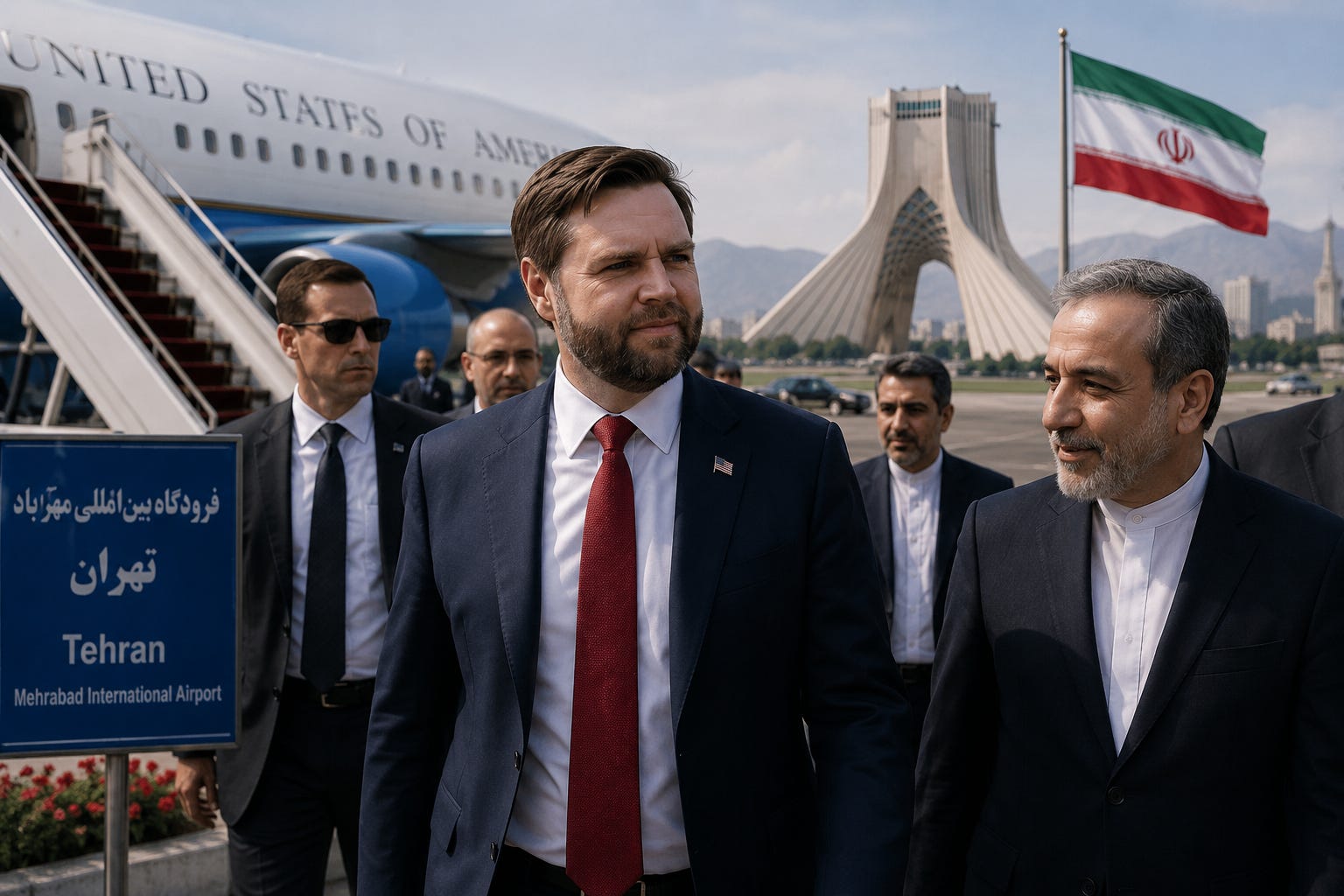
Few images in international politics seem less plausible than Air Force Two landing in Tehran carrying an American vice president. For nearly half a century, the relationship between the United States and Iran has been defined by sanctions, proxy wars, mutual hostility, and recurring crises. Yet history is full of diplomatic breakthroughs that once appeared impossible—from Nixon’s visit to Beijing to the Iran-Saudi rapprochement brokered in Beijing. Today, paradoxically, after years of maximum pressure, direct military confrontation, and regional turmoil, Washington and Tehran may be closer than ever to redefining their relationship.
The Unthinkable Is Becoming Thinkable
Imagine Air Force Two touching down in Tehran, carrying Vice President JD Vance for talks with Iranian President Masoud Pezeshkian. For nearly half a century, such an image would have belonged more to political fiction than diplomatic reality. Since the 1979 Islamic Revolution, relations between Washington and Tehran have been defined by hostage crises, sanctions, proxy conflicts, military confrontations, and deep mutual mistrust.
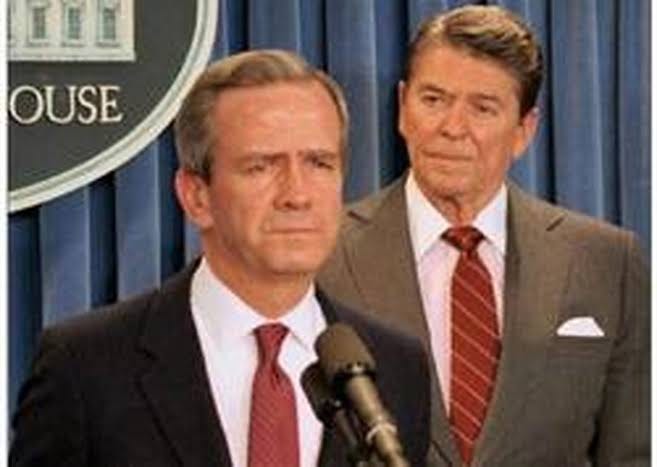
The idea of high-level engagement is not entirely unprecedented. In 1986, President Ronald Reagan secretly dispatched National Security Adviser Robert McFarlane to Tehran in an attempt to open a strategic dialogue with Iran. The mission ended in humiliation for both sides. The secret contacts were exposed, triggering the Iran-Contra scandal in Washington while embarrassing Iranian leaders domestically and reinforcing suspicions on both sides. Rather than opening a new chapter, the episode deepened hostility and made future engagement politically toxic.
Yet history rarely moves in straight lines. Paradoxically, despite recent wars, direct military confrontations, and years of maximum pressure, the United States and Iran may now be closer than ever to a historic accommodation.
The reason is simple: the recent wars demonstrated the limits of military coercion for both Washington and Tehran. The United States discovered that sanctions, military pressure, and even direct confrontation could not compel Iran to surrender or fundamentally alter its strategic posture. Iran, for its part, learned that while it could impose significant costs on its adversaries, perpetual confrontation carries enormous economic and security risks that might lead to system collapse.
Having tested escalation and survived it, both sides increasingly appear to recognize that coexistence—even between adversaries—may be less costly than endless conflict. The road to reconciliation remains long and uncertain, but for the first time in decades, the unthinkable no longer seems impossible.
Why the War Was Necessary
Paradoxically, the recent war may have been a necessary stage on the path toward a possible US-Iran accommodation. For decades, both sides believed that time, pressure, and deterrence would eventually force the other to concede. The war tested these assumptions in the most direct way possible. It revealed not only the strengths of each side, but also the limits of their power.
For Washington
Despite being widely viewed as highly risky, a military confrontation with Iran had remained an attractive option for successive American administrations. Many in Washington believed that only the credible threat—or actual use—of force could compel Tehran to accept a fundamentally different relationship with the United States and the regional order.
Donald Trump was the first president willing to take that gamble. Convinced that the Islamic Republic was at its weakest point domestically and regionally, he sought to force a better deal than the JCPOA and perhaps even alter the strategic behavior of the regime itself. The war became the ultimate test of the maximum pressure strategy.
Washington also needed to demonstrate resolve—to Israel, to Gulf allies, and to domestic audiences skeptical of American deterrence after years of regional retrenchment. Yet the conflict simultaneously exposed the limits of American power and, more importantly, the limited willingness of the United States to sustain another major Middle Eastern war.
What initially appeared as a show of strength gradually turned into an escalation trap. The administration ultimately faced two unappealing choices: either escalate toward a much larger war involving unconventional weapons, prolonged air campaigns, and potentially a ground confrontation that could drag the United States into a disaster even more costly than Iraq or Vietnam; or accept compromise and return to negotiations in search of a deal attractive enough for Tehran to accept. Washington eventually chose the latter.
For Tehran
Iran also entered the conflict believing that its multilayered deterrence system would prevent direct war. Over decades, Tehran had constructed a sophisticated network of non-state regional allies, developed one of the region’s most advanced missile programs, and accumulated significant nuclear capabilities through high-level uranium enrichment.
Yet the war demonstrated the limits of these deterrent tools as well. None proved sufficient to prevent military confrontation or eliminate the possibility of an existential threat to the Islamic Republic. Iran discovered that while it could survive direct confrontation, the long-term economic, political, and security consequences of sustained conflict could be extremely dangerous.
A famous quote from former supreme leader Ayatollah Ali Khamenei summorizes the previous stance: “There won’t be a war, and we won’t negotiate”. However, after the war, his successor, Mujtaba Khamenei, said: “He dislikes dealing with the U.S., but he allowed it”.
At the same time, the war provided Tehran with an opportunity to redraw deterrence and establish new red lines. Iranian leaders sought to demonstrate that attacks on Iran itself would impose unacceptable costs on its adversaries. Although the conflict did not eliminate the prospect of future confrontations, it significantly strengthened Iran’s deterrent posture.
Surviving the war increased the regime’s confidence and improved its bargaining position. Yet it also reinforced another lesson: the long-term survival and stability of the Islamic Republic may ultimately require ending, or at least managing, its hostility with the United States through a sustainable and mutually acceptable arrangement.
Ironically, both sides needed the war to discover the same reality: neither could impose its preferred outcome through force.
China and Russia: Indirectly Pushing Toward Compromise
Another factor pushing Washington and Tehran toward accommodation has been the role played—largely indirectly—by China and Russia. Neither Moscow nor Beijing intervened militarily on Iran’s behalf during the recent wars. Yet their restrained support may have delivered an important strategic lesson to both Tehran and Washington.
For Iran, the conflict exposed the limits of reliance on its traditional great-power partners. Although China and Russia provided diplomatic backing, economic cooperation, intelligence support, and political coverage in international forums, neither was willing to enter the conflict directly or assume significant costs on Iran’s behalf. Tehran discovered that, unlike North Korea’s relationship with China, it could not expect an unconditional security guarantee.
More importantly, Iranian leaders have little interest in becoming strategically subordinate to either Moscow or Beijing. Such dependence would reduce Iran to a weaker and more isolated state, largely confined to trading with these two powers while remaining cut off from broader global markets and institutions. The Islamic Republic has historically sought strategic autonomy and has consistently rejected becoming a junior partner to any external power, whether Eastern or Western. The war reinforced the necessity of diversifying Iran’s international relations and reducing its isolation through some form of accommodation with the West.
Washington reached a different but equally important conclusion. Continued maximum pressure and further military escalation risked pushing Iran even deeper into the orbit of Russia and China. Such an outcome would fundamentally alter the regional balance of power and further weaken American influence in the Middle East. A permanently isolated Iran with no option but to rely on Moscow and Beijing would not necessarily serve US strategic interests, particularly at a time when Washington increasingly views China as its principal global competitor.
From this perspective, the war highlighted an uncomfortable reality for both sides. Iran realized that neither Russia nor China could substitute for normalized relations with the broader international system. The United States realized that excessive pressure could accelerate the emergence of a stronger anti-American alignment linking Tehran more closely with Moscow and Beijing.
Paradoxically, therefore, China and Russia may have contributed to peace not by intervening in the conflict, but by demonstrating to both Washington and Tehran the strategic limits of confrontation. Their position indirectly pushed both sides toward compromise, making negotiations appear less like a concession and more like a strategic necessity.
A Changing of the Guard: New Thinking in Washington and Tehran
A lasting accommodation between the United States and Iran has become more conceivable not only because of the recent wars, but also because both countries are undergoing important strategic transformations. The political forces that shaped four decades of hostility are gradually giving way to new generations with different priorities and understandings of power.
In the United States, the era of the neocon project that dominated Washington after the end of the Cold War appears largely over. The ambition to export democracy through military intervention and pursue regime change as a central pillar of American foreign policy has lost much of its appeal after the costly experiences of Iraq and Afghanistan. Across the political spectrum, there is now little appetite for another large-scale Middle Eastern war.
Instead, a new foreign policy consensus has emerged, best reflected in Trump’s “America First” doctrine. While far from isolationist, this approach favors minimizing costly military commitments abroad, reducing direct involvement in regional conflicts, and focusing American resources on strategic competition with major powers, particularly China. From this perspective, endless confrontation with Iran increasingly appears as a distraction rather than a strategic necessity.
Important voices in both the Republican and Democratic parties now prefer burden-sharing, regional balancing, and transactional diplomacy over nation-building and regime change. This does not mean that Washington has abandoned coercion or military pressure, but it does suggest that future American administrations are likely to be more interested in managing rivalry with Iran than overthrowing the Islamic Republic.
Iran is experiencing a parallel, though different, transformation. A new generation of military and political elites is gradually assuming greater influence within the system. Unlike the revolutionary generation that founded the Islamic Republic, many of these figures are less driven by ideology and more by strategic calculation and state interests.
This emerging technocratic class does not seek to abandon Iran’s sources of power—its missile program, regional alliances, or nuclear capabilities. Rather, it increasingly views these assets as bargaining chips that can be strategically exchanged for other forms of power, including economic development, technological modernization, sanctions relief, and international legitimacy.
For this new generation, the central objective is not permanent confrontation but preserving the system while adapting it to a changing regional and international environment. In this sense, engagement with the United States is increasingly viewed not as ideological surrender, but as a potential instrument for strengthening the Iranian state.
These parallel shifts do not eliminate the profound differences separating Washington and Tehran. Yet they do create a political environment in which compromise has become more conceivable than at any time in recent decades. For the first time in a generation, influential actors on both sides appear more interested in managing hostility than perpetuating it indefinitely.
A Shifting Regional Dynamic
Another reason this moment may be different from previous attempts at US-Iran rapprochement is the dramatic change in the regional environment. Unlike in 2015, when several regional actors viewed the JCPOA with deep suspicion, today almost every major regional power—with the notable exception of Israel—supports some form of accommodation between Washington and Tehran.
The Gulf states, once among the strongest advocates of maximum pressure on Iran, have increasingly shifted toward de-escalation and engagement. Years of regional conflict, attacks on energy infrastructure, and economic uncertainty have convinced many Arab governments that stability is more valuable than confrontation. The Iran-Saudi rapprochement brokered by China in 2023 was perhaps the clearest indication of this strategic shift.
At the same time, the Gaza war has significantly altered Israel’s regional and international position. While Israel remains America’s closest ally in the Middle East, the war has deepened tensions between Washington and Tel Aviv and exposed growing differences over regional strategy. Increasing international criticism of Israeli policies, combined with concerns in Washington about the costs of endless regional escalation, has left Israel more isolated than at any point in recent decades.
This changing regional landscape creates an important opportunity. For the first time in years, both Washington and Tehran are operating in a largely supportive regional environment that favors de-escalation rather than confrontation. Regional powers increasingly see a US-Iran understanding not as a threat, but as a prerequisite for stability, economic development, and the avoidance of another catastrophic war.
In other words, the diplomatic path that once faced strong regional resistance now enjoys broad regional support. That does not guarantee success, but it significantly improves the prospects for finding a common ground between the United States and Iran.
The MoU as an Emerging Roadmap: Why This Moment Is Different
The emerging memorandum of understanding between the United States and Iran falls far short of a peace treaty. It does not resolve the fundamental disputes that have divided the two countries for nearly half a century. Yet it may represent something equally significant: a roadmap for managing rivalry rather than perpetuating confrontation.
The framework includes several important elements: a ceasefire and broader de-escalation, the reopening of the Strait of Hormuz, limited sanctions relief and the release of some frozen Iranian assets, and a timetable for future negotiations on the central issue—the nuclear program. More broadly, it could open the door to wider regional de-escalation, particularly in Iraq, Lebanon, and the Gulf.
Such efforts are not new. Previous attempts at rapprochement repeatedly failed because of deep mistrust, powerful domestic opposition on both sides, regional spoilers, and fundamentally different expectations about the end state of negotiations. Washington often sought transformational change in Iranian behavior, while Tehran sought recognition, security guarantees, and sanctions relief without sacrificing what it considered core sovereign rights.
What makes the current moment different is that both sides have now experienced direct war. The costs have been substantial for Washington, Tehran, and the wider region. The United States discovered the limits of coercion, while Iran learned that even a successful deterrence strategy cannot eliminate the dangers of prolonged conflict.
Moreover, the strategic incentives have changed. Trump needs stability: politically, economically, and strategically. Another prolonged Middle Eastern war would undermine his broader domestic and international agenda. Iran, meanwhile, urgently needs economic relief, investment, and reintegration into global markets after years of sanctions and conflict. Regional states, particularly in the Gulf, overwhelmingly support de-escalation, having witnessed firsthand the economic and security costs of confrontation.
Most importantly, there now appears to be a meaningful area of overlap between American and Iranian interests.
Neither side seeks the complete elimination of the other. Washington increasingly appears willing to tolerate Iran as a limited regional power, provided that Tehran’s influence remains bounded and does not directly threaten American interests or regional partners. Tehran, for its part, appears prepared to accept a regional order in which it remains influential but not hegemonic.
Similarly, while Iran’s missile program remains contentious, it no longer appears to be the central obstacle to an agreement. A compromise on the nuclear issue could create sufficient political space for both sides to manage disagreements over missiles and regional influence without allowing them to derail the broader relationship.
In other words, for the first time in decades, Washington and Tehran may have identified a common strategic ground on which to meet. The emerging MoU is not peace. But it may be the first serious attempt by both sides to replace a cycle of endless hostility with a framework for managed competition and coexistence.
Conclusion: Waiting for Air Force Two
The image of Air Force Two landing in Tehran, carrying Vice President JD Vance, may still appear improbable. Few in the early 1970s could have imagined Richard Nixon walking through Beijing and shaking hands with Mao Zedong, bringing an end to more than two decades of hostility between the United States and China.
History rarely changes because adversaries suddenly become friends. More often, it changes when both sides conclude that endless conflict no longer serves their interests.
None of this guarantees peace. Deep mistrust remains, domestic opposition persists, and some regional spoilers, particularly Israel, will continue to resist any rapprochement. The road ahead will be long, fragile, and vulnerable to setbacks.
But for the first time in decades, the strategic logic on both sides may be moving in the same direction: away from perpetual confrontation and toward managed coexistence. The destination may still be distant, but the journey may already have begun.
