

The Pentagon has recently released the 2026 U.S. National Defense Strategy (NDS), a document that outlines Washington’s global defense priorities and threat assessments. The strategy identifies a short list of group of states—China, Russia, North Korea, and Iran—as central to U.S. security planning, underscoring Iran’s significance in American defense thinking. The document details how the United States assesses Iran’s capabilities, perceives the risks posed by Tehran, and intends to manage, deter, or counter them in the years ahead. This article examines what the strategy reveals about U.S. thinking on Iran and the implications for Tehran’s strategic future.
What the Strategy Says About Iran?
The 2026 U.S. National Defense Strategy places Iran firmly within Washington’s top tier of security concerns. By grouping Iran alongside China, Russia, and North Korea, the document signals that Tehran is no longer viewed merely as a regional problem, but as a strategic adversary whose actions affect U.S. global interests. This framing elevates Iran’s status in the U.S. threat hierarchy and justifies sustained military attention, even as Washington prioritises competition with great powers.
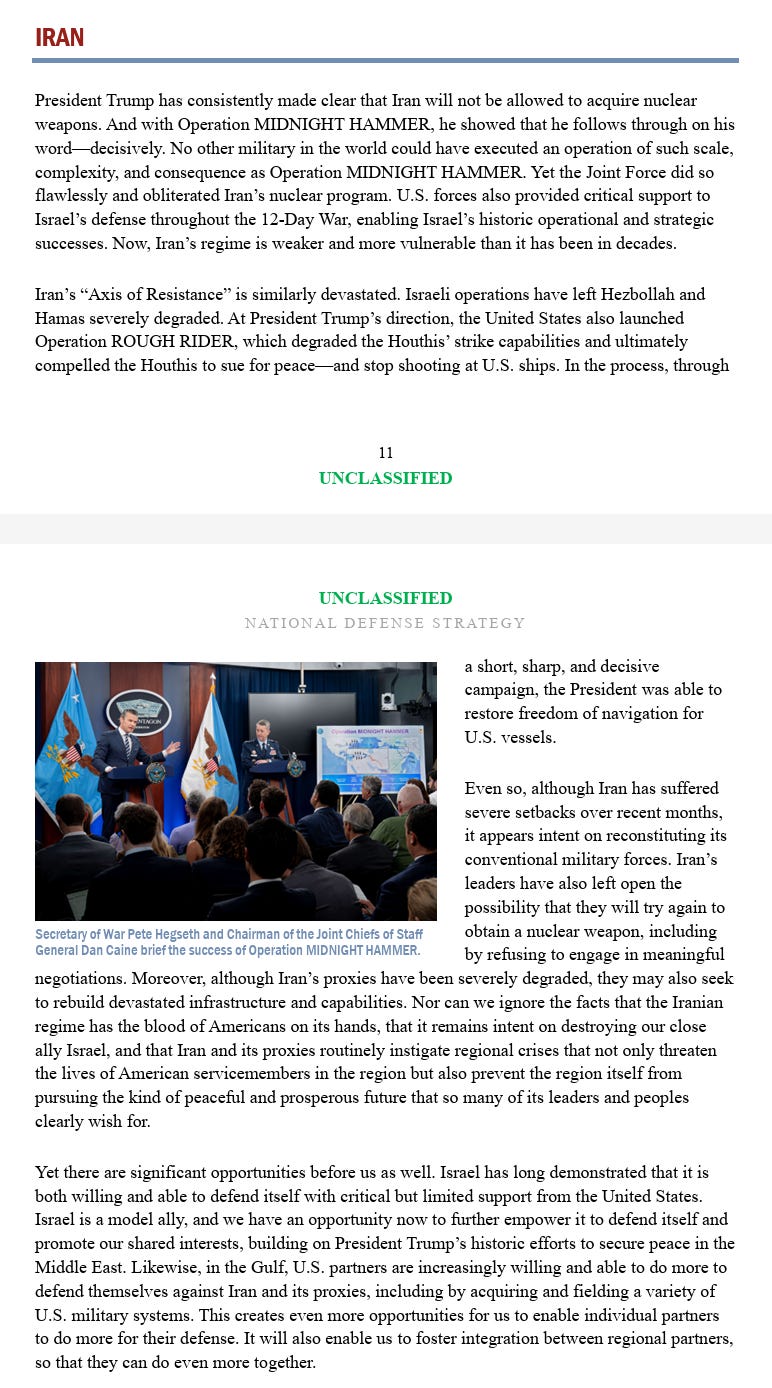
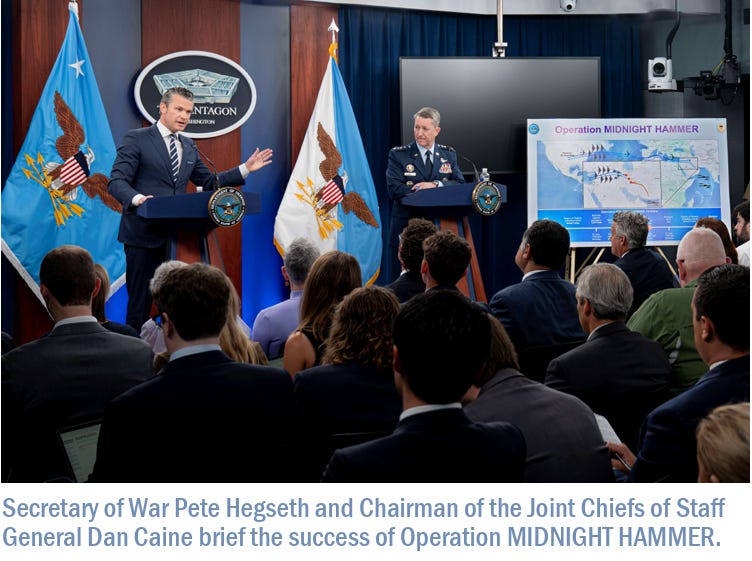
The language used in the strategy is unusually blunt. It reiterates that Iran will not be allowed to acquire nuclear weapons and presents recent U.S. military actions as proof of resolve and capability. The document describes Iran’s nuclear program as having been effectively dismantled through decisive military action and portrays this outcome as a demonstration of unmatched U.S. operational superiority. At the same time, it leaves no ambiguity about Washington’s assessment that Tehran may attempt to rebuild its nuclear and conventional military capabilities, especially if it refuses to engage in what the U.S. defines as “meaningful negotiations.”
Regionally, Iran is framed primarily through the lens of its network of allies and proxies. The strategy argues that Iran’s so-called “Axis of Resistance” has been severely degraded, citing the weakening of Hezbollah, Hamas, and the Houthis as strategic successes for the U.S. and its partners. Yet this assessment is paired with a warning: despite recent setbacks, Iran and its proxies remain capable of reconstitution and continued destabilisation. Iran is portrayed not only as a persistent military challenge, but as a state that routinely fuels regional crises, threatens U.S. forces, and remains committed to the destruction of Israel.
Crucially, the strategy situates deterrence of Iran within a broader regional realignment. Rather than relying on large-scale U.S. deployments, Washington’s approach emphasises empowering regional allies—particularly Israel and Gulf states—to take primary responsibility for countering Iran. The document highlights Israel as a “model ally” and stresses deeper military integration between Israel and Arab partners, explicitly linking this to the Abraham Accords. In this framework, Iran is the central threat around which a new regional security architecture is being constructed.
Taken together, the strategy presents Iran as weakened but dangerous: diminished in capability, yet undeterred in intent. Its placement alongside other major adversaries signals that the United States views Iran less as a candidate for reconciliation and more as a long-term problem to be managed through pressure, deterrence, and regional containment rather than accommodation.
How Iran Has Been Weakened?
The 2026 U.S. National Defense Strategy presents Iran as a state that has suffered significant degradation across economic, military, and regional dimensions, even if it remains dangerous and defiant. While the document avoids detailed metrics, its language reflects a clear assessment in Washington: Iran today is weaker, more constrained, and more vulnerable than it has been in decades.
One central factor is economic pressure. U.S. officials have been explicit about the intended impact of sanctions. Treasury Secretary Scott Bessent has stated that U.S. sanctions pushed Iran into a deep economic crisis that directly affected ordinary people and contributed to widespread social unrest. From Washington’s perspective, this economic strain is not a side effect but a core instrument of pressure—designed to limit state capacity, weaken public-sector patronage, and erode the regime’s ability to buy social stability.
Years of sanctions have crippled key sectors of Iran’s economy, sharply reduced oil revenues, driven inflation and currency collapse, and undermined access to medicine, food security, and basic services. While President Trump has claimed that sanctions are intended to pressure the regime rather than harm the population, in practice the economic burden has fallen disproportionately on ordinary Iranians—fueling public anger and repeated waves of protest.
Iran has also been weakened by regional military confrontation. The aftermath of the 7 October attacks marked a turning point, drawing Iran into a sustained confrontation with Israel across multiple fronts. Israeli operations significantly degraded Iran-aligned militias, including Hezbollah and Hamas, eroding what Tehran has long relied on as forward deterrence. The subsequent 12-day war further exposed vulnerabilities in Iran’s defensive capabilities, from air defense to command-and-control systems, reinforcing U.S. confidence in its ability to strike Iranian assets decisively if needed.
Internally, these pressures intersect with persistent instability. Economic hardship, elite anxiety, intelligence penetration, and repeated mass protests have strained the regime’s governance capacity. While Iran’s security apparatus remains large and loyal, U.S. policymakers increasingly view the state as overextended—forced to manage domestic unrest, economic crisis, and regional setbacks simultaneously.
Taken together, the strategy reflects a U.S. interpretation of Iran as a power whose strategic depth has narrowed. Sanctions have constrained resources, military pressure has exposed limits, regional conflicts have weakened proxy networks, and internal unrest has reduced political resilience. This does not mean Iran is near collapse—but it does mean Washington believes Tehran is operating from a position of cumulative weakness rather than strength, a belief that underpins the strategy of sustained pressure, deterrence, and containment outlined in the 2026 NDS.
What the U.S. Defense Strategy Toward Iran Actually Is?
The 2026 U.S. National Defense Strategy reflects a calibrated strategy of deterrence and coercion, rather than direct confrontation or classic regime-change warfare. The central objective is clear: Iran must not be allowed to rebuild its strategic deterrent, whether nuclear, missile-based, or regional. Washington’s focus is on preventing reconstruction of Iran’s defense capabilities and rolling back its regional presence so that Iran remains strategically weakened and constrained.
Crucially, this strategy does not prioritise regime change. Unlike neoconservative models pursued in the early 2000s, the current approach accepts the continued existence of the Iranian regime and seeks instead to reshape its behaviour. The goal is not to overthrow the system, but to force it to operate within limits defined by U.S. interests—particularly on nuclear weapons, missile development, and support for regional armed groups.
This approach resembles the Venezuela model more than the Iraq model: eliminating or degrading specific state capacities, imposing maximum economic and military pressure, and leveraging internal strain to compel compliance. It is a carrot-and-stick strategy embedded within broad psychological warfare, delivering a stark message to Tehran: accept “peace on U.S. terms,” or face sustained, destructive pressure without the deployment of American ground forces.
Military pressure plays a central role, but it is designed to remain limited and asymmetric. Rather than full-scale war, the strategy relies on precision strikes, sanctions, intelligence operations, and persistent threat signaling—combined with regional burden-sharing. Israel and Gulf partners are empowered to shoulder more of the deterrence mission, while Washington retains the ability to deliver focused, decisive action when necessary.
Another notable feature of this strategy is the elimination of the middle ground. Iran is not being offered incremental concessions or partial reintegration. Instead, the space for manoeuvre is narrowed to two outcomes: voluntary compliance under extreme pressure, or enforced compliance through sustained erosion of power. In this framework, Iran’s traditional tools—regional proxies, strategic ambiguity, and calibrated escalation—are systematically targeted and stripped away.
The result is a strategy aimed at long-term erosion rather than sudden collapse. By keeping Iran weak but intact, Washington seeks to neutralise Tehran as a strategic actor without triggering the chaos and regional instability that outright regime change would likely produce. Whether this approach can succeed without provoking escalation—or whether it ultimately creates new existential pressures that destabilise the regime anyway—remains the defining question of the strategy.
Implications for Iran
The U.S. defense strategy outlined in the 2026 National Defense Strategy reshapes Iran’s future security environment in fundamental ways. Iran is now operating under a framework designed to deny recovery rather than merely deter aggression. This means sustained pressure on every pillar of Iranian power—nuclear capability, missile development, regional networks, and economic resilience—without the stabilising prospect of reintegration or normalisation. The result is a far more constrained strategic space, where even defensive reconstruction is treated as a provocation.
This posture significantly raises the risk of escalation, even if neither side actively seeks full-scale war. By narrowing Iran’s options and framing restraint as weakness, the strategy incentivises Tehran to demonstrate resolve through asymmetric retaliation, proxy activity, or calibrated regional disruption. At the same time, Washington’s reliance on partners and indirect pressure increases the likelihood of miscalculation, where localised clashes spiral into broader confrontation without clear off-ramps.
Diplomacy remains formally available, but it is highly conditional and asymmetric. Negotiation is offered not as mutual compromise, but as compliance under duress. Any deal would require Iran to surrender core elements of its deterrence and regional posture, concessions that strike at the ideological and strategic foundations of the regime. As a result, diplomacy under this framework is less a path to stabilisation than a test of regime survival, making voluntary acceptance politically dangerous for Tehran.
In response, Iran is likely to pursue a dual-track strategy. On one hand, it will seek to avoid direct war with the United States by calibrating retaliation and maintaining ambiguity. On the other, it will attempt to preserve leverage by quietly rebuilding capabilities, deepening ties with non-Western powers, and exploiting regional and global divisions. Internally, the regime may further securitise politics to manage pressure, even as economic strain and social discontent intensify.
Ultimately, this evolving U.S. posture places Iran in a prolonged state of strategic limbo: too constrained to act freely, too pressured to concede safely, and too intact to collapse quickly. Whether this environment produces forced accommodation, dangerous escalation, or slow internal erosion will depend not only on Tehran’s choices, but on how rigidly Washington enforces a strategy that leaves Iran with increasingly few acceptable outcomes.
