

Nearly seven months into the war with Iran, Donald Trump used his address to the UN General Assembly to say that he now faces a “big decision.” He presented it in stark terms: either reach an agreement that allows Iran to rebuild, or dramatically escalate the war against the Islamic Republic. At the same time, Trump predicted that a deal could come after the November midterm elections, accusing Tehran of waiting to see whether the vote changes his political position at home.
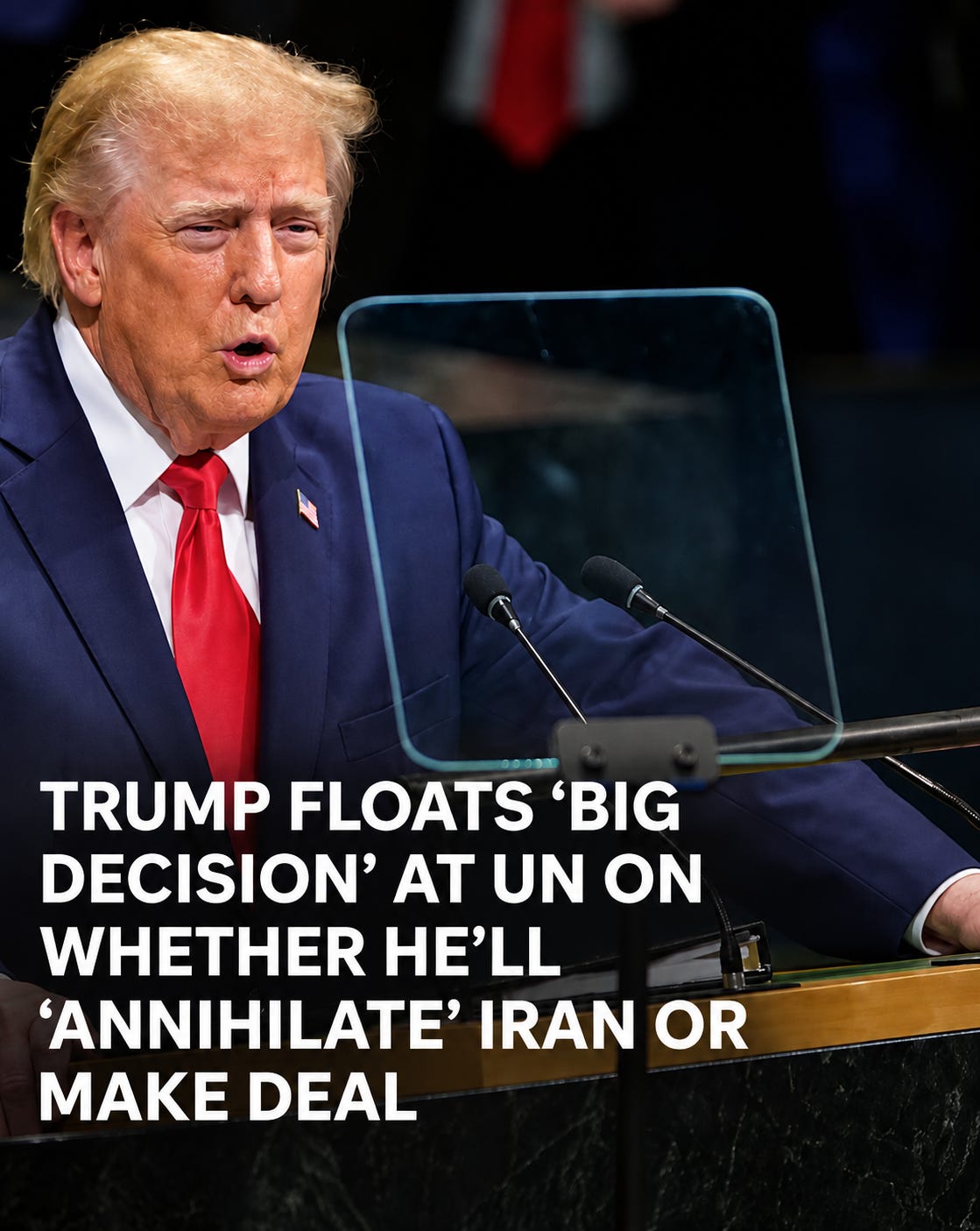
The threat came at an unusual moment. On the same day, US and Iranian officials held indirect talks for around three hours on the sidelines of the UN gathering, mediated through intermediaries. Trump later described it as a “very good meeting.” The combination of talks and threats captures where the conflict now stands: diplomacy has not disappeared, but neither side is prepared to pursue it without maintaining pressure on the other.
Seven months of war have significantly altered the regional balance and handed Iran some new cards, but neither Washington nor Tehran has achieved the political outcome it sought. The United States has demonstrated its overwhelming capacity to strike Iran and damage its military and strategic infrastructure. What it has not yet done is translate that military superiority into a settlement on American terms. Iran, meanwhile, has survived the initial military shock and retained important instruments of pressure, particularly its missile capabilities and its leverage over regional shipping routes. But Tehran has also failed to achieve its central objective: ending the military and economic threat against it and securing conditions under which it can rebuild without the prospect of another round of war. The continuing disruption around the Strait of Hormuz has become one of the most consequential pressure points in this struggle, affecting not only the two belligerents but Gulf states and global energy markets.
Both sides have therefore climbed an escalation ladder from which the exits are becoming increasingly costly. For Washington, accepting Iranian demands risks making months of military escalation look as though they ended in concessions. For Tehran, accepting Washington’s terms under military pressure could leave it vulnerable to renewed coercion later. Yet further escalation carries costs neither side can fully control.
Trump describes the decision as a choice between a deal and overwhelming force. The reality is less binary. Washington has at least four paths available: negotiate a settlement, return to major military escalation, continue maximum pressure without a full-scale war, or allow the confrontation to settle into a prolonged conflict that neither side formally chooses but both learn to manage. None offers Trump an easy endgame.
1. Make the Deal Trump Says He Wants
The most obvious option for Trump is the one he has repeatedly demanded: make a deal. But reaching one now would be considerably more difficult than it was a few months ago. The war has changed the dynamics. It has not degraded the Islamic Republic to the point where it has little choice but to accept Washington’s terms. Instead, it has also handed Tehran new bargaining cards, particularly its ability to disrupt shipping through the Strait of Hormuz, exert pressure around Bab al-Mandab through its regional allies, and causing significant damage to US military assets and interests across the region. Any agreement reached now would therefore look very different from the kind of deal Trump envisaged before the war, when the expectation was that military pressure would weaken Iran’s negotiating position and make a settlement on US terms easier to achieve. Equally, a deal that allowed Tehran to present the outcome as an Iranian victory would be politically difficult for Trump to accept.
The experience of the Islamabad Memorandum of Understanding illustrates this problem. In June, following talks mediated by Pakistan, Washington and Tehran agreed to a 14-point framework intended to end military operations and provide a 60-day window for negotiating a final settlement. The arrangement did not survive. Fighting resumed, the two sides accused each other of violations, and Trump announced that he was withdrawing from the agreement before it formally expired in August.
The collapse of the Islamabad agreement matters because it deepened distrust on both sides and raised the price of returning to negotiations. For Tehran, the failure of the agreement strengthened the argument that another ceasefire has little value without stronger guarantees that Washington will abide by it. For Washington, however, providing Iran with additional concessions or guarantees creates the opposite problem. The more concessions Tehran extracts after surviving months of US military pressure, the easier it becomes for the Iranian leadership to portray the outcome as evidence that it withstood the war and forced Washington to compromise. That would make it much harder for Trump to present the settlement as an American victory rather than an acknowledgment of the limits of military pressure.
Iran has consequently set a much higher threshold for returning to negotiations. Mohsen Rezaei, secretary of Iran’s Supreme National Security Council, said Tehran had transmitted seven conditions to Washington through Qatar. Only some have been made public, including an end to the war on all fronts, the release of frozen Iranian funds and an end to the US naval blockade. These are not simply preconditions for discussing the pre-war nuclear dispute. They reflect the new realities created by the war and Iran’s attempt to ensure that any negotiation also addresses the military and economic pressure it has faced during the conflict.
Washington’s demands have been also expanding due the results of the war. For Washington, now it is not only about the nuclear issue, but also also issues created or intensified by seven months of warfare: sanctions, frozen assets, the naval blockade, freedom of navigation through Hormuz, Iran’s missile capabilities and the broader regional security environment.
This creates a difficult political problem for Trump. Any serious agreement will require Washington to give Iran something in return—whether sanctions relief, access to frozen funds, changes to the naval blockade, security guarantees, or some combination of these. After seven months of war and repeated claims that Iran has been severely weakened, accepting significant Iranian demands could make it harder for Trump to present the eventual settlement as the victory for which the war was fought. Tehran faces the mirror image of the same problem: after absorbing months of attacks, it cannot easily accept an agreement that appears to reward military coercion.
The obstacle, then, is no longer simply getting Washington and Tehran back to the negotiating table. It is finding a deal that both can accept while allowing each to argue that seven months of war strengthened rather than weakened its position. Paradoxically, the war that was supposed to make a deal easier may have made the political price of reaching one considerably higher for both sides.
2. Return to Major Military Escalation
Trump’s second option is to do what his warning to “annihilate” the Islamic Republic implies: escalate the war dramatically. The United States unquestionably retains the military capacity to inflict far greater damage on Iran. The more difficult question is what escalation would achieve politically. After nearly seven months of conflict, further bombing would have to do more than destroy another missile facility, naval installation or command centre. It would have to compel Tehran to accept terms it has so far refused. Iran’s previous responses suggest that further attacks could instead produce another, potentially more destructive, round of retaliation. Iranian attacks have already damaged US military facilities across several Gulf states, while the conflict has severely disrupted shipping through Hormuz and contributed to wider pressure on regional energy infrastructure.
This leaves Trump facing what might be called an escalation trap. Having already used extensive conventional air power without securing Iran’s capitulation, each additional step has to be more consequential than the one before it if escalation is to retain its coercive credibility. Yet the more destructive the American action becomes, the greater the incentive for Iran to widen its own response. At the extreme end, three broad options remain available, but each carries risks that could outweigh whatever immediate military advantage it produces.
The first would be the use of a tactical nuclear weapon against deeply buried or otherwise difficult-to-destroy targets. There is no public evidence that Trump has decided to take such a step, and it should therefore be treated as an extreme hypothetical rather than an imminent option. But if Washington crossed the nuclear threshold, the consequences would extend far beyond Iran. Tehran would have a powerful incentive to respond with its most destructive remaining conventional capabilities and to expand the geography of the conflict, rather than capitulate. More importantly, the first wartime use of a nuclear weapon since 1945 would break a taboo that has endured for more than eight decades. That could weaken the broader international restraint surrounding nuclear weapons at precisely the moment Russia has repeatedly used nuclear threats in connection with its war in Ukraine and has revised its doctrine in ways that experts say lower the threshold for their use. It would not automatically cause Russia to use nuclear weapons in Ukraine, but it could make the international norm against doing so substantially harder to sustain.
A second option would be a much broader conventional campaign against Iran’s civilian and economic infrastructure: energy facilities, ports, transport networks, industrial capacity and other assets that allow the state and economy to function. Such attacks could impose enormous costs on Tehran, but they would also give Iran an incentive to respond on the same level. Iran has already demonstrated an ability to impose costs beyond its own territory, almost the entire region. A shift from predominantly military targets towards critical economic infrastructure could therefore transform the conflict from a US-Iran war into a struggle over the infrastructure of the wider Gulf.
That would be particularly dangerous because the Gulf is not simply another theatre of war. It contains some of the world’s most important oil and gas facilities, ports, desalination plants, airports and shipping routes. A sustained exchange involving such infrastructure—combined with continued disruption in Hormuz and pressure around the Red Sea and Bab al-Mandab—could transmit the costs of escalation rapidly into global energy prices, shipping, insurance and supply chains. Iran would not need to match American military power to impose substantial economic costs; it would need only to make the regional infrastructure on which the global economy depends considerably less secure.
The third and most radical option would be to put substantial numbers of American troops on Iranian soil. Limited ground operations have already been considered in Washington, including plans involving Iran’s enriched-uranium stockpile, but a full-scale invasion would be an entirely different undertaking. Iran’s size, population, geography and military capabilities mean that overthrowing the government would be only the beginning. Washington would then face the much harder question that followed its interventions in Iraq and Afghanistan: what comes next?
Occupation, insurgency, state reconstruction and the management of a country of more than 90 million people could drag the United States into precisely the kind of open-ended Middle Eastern war Trump has long claimed he wants to avoid. Current assessments also indicate that the force presently deployed in the region is far below what a major ground operation would require.
3. Continue Maximum Pressure Without Returning to Full-Scale War
The third option is the middle ground between the two alternatives Trump presented at the UN: neither make the concessions necessary for a deal nor take the risks involved in another major military escalation. Instead, Washington could continue tightening the economic, financial and diplomatic pressure on Tehran while maintaining the threat of military action in the background.
There are already signs that this is the direction Washington is pursuing. On September 8, the US Treasury imposed sanctions on 36 targets connected to Iran’s aviation sector, including 27 Iranian airlines, while also targeting foreign companies and intermediaries accused of helping Tehran maintain access to aircraft, technology and international services. The measures were designed not simply to sanction individual entities but to further restrict Iran’s economic connectivity with the outside world. Similar pressure has been applied through financial restrictions, secondary sanctions and efforts to close the networks Iran has developed to move money and goods around existing sanctions.
Trump made the broader objective explicit at the UN, calling on other countries to join Washington in economically isolating Iran. Maximum pressure, in this sense, offers an attractive alternative to further military escalation. It allows Trump to argue that Iran remains under sustained pressure without assuming the enormous risks associated with attacks on critical infrastructure, nuclear escalation or a ground war. It also leaves the door open to negotiations if Tehran eventually concludes that the economic cost of continuing the confrontation is greater than the cost of compromise.
But the history of the Islamic Republic raises questions about how much this strategy can actually achieve. Iran has lived under varying degrees of US sanctions for more than four decades and under particularly intense pressure since Trump withdrew from the nuclear agreement in 2018. That experience has not made sanctions painless. They have imposed enormous costs on the Iranian economy and, perhaps more importantly, on ordinary Iranians. But the state has also developed considerable experience in surviving them. Tehran has built alternative financial and commercial networks, relied increasingly on trade with China and other non-Western economies, expanded informal and illicit channels, used neighbouring states as commercial gateways, and adapted domestic economic institutions to operating under prolonged isolation. The result is not a healthy economy, but an economy and political system accustomed to functioning under pressure.
The international environment also makes complete isolation difficult. Russia and China demonstrated those limits on September 17 when they vetoed a US-backed Security Council resolution that would have extended the mandate of the UN panel monitoring sanctions on Iran. The underlying UN sanctions remain in place, but the veto ended the independent monitoring mechanism Washington wanted to preserve. China and Russia also continue to provide Iran with economic and diplomatic alternatives that did not exist on the same scale during earlier periods of Western pressure.
There is also a question of time. From Tehran’s perspective, maximum pressure does not necessarily have to be defeated; it may simply have to be survived. Trump has a little more than two years remaining in his current term, and there is no certainty that the next US administration will maintain the same combination of sanctions, military pressure and regional strategy. A new president taking office in January 2029 could preserve much of Trump’s policy, modify it or seek another diplomatic opening. Iran therefore has an incentive to calculate that enduring another two years of severe pressure may be preferable to accepting a settlement now that it considers strategically damaging. This does not mean that Tehran can know what the next administration will do. It means only that the finite duration of any presidency gives Iran another variable around which to build its strategy.
That calculation is particularly important because maximum pressure works best when the target believes the pressure will continue indefinitely or until it changes course. If Tehran instead believes that it can absorb the economic damage, keep enough external channels open through China, Russia and neighbouring states, and wait for the American political cycle to change, time itself becomes part of Iran’s strategy.
This exposes the central weakness of the maximum-pressure option: pressure toward what? Sanctions can reduce Iran’s revenues, restrict its international connections and make maintaining its military and economic infrastructure more expensive. They can also create incentives for negotiation. What they cannot guarantee is that Tehran will accept Washington’s political terms.
Without a settlement that Iran can realistically accept, maximum pressure risks becoming less an instrument for ending the conflict than a mechanism for managing it. Washington would continue squeezing Iran, Tehran would continue developing ways around that pressure, military threats would remain in the background, and both sides would wait for circumstances to shift in their favour. For Trump, maximum pressure may therefore be the least immediately dangerous option, but it carries its own strategic problem: the Islamic Republic has spent decades learning how to survive pressure, while Trump is working against a much shorter political clock.
4. Accept a Prolonged Ferris wheel Conflict
There is a fourth possibility that neither Washington nor Tehran would formally choose, but which may emerge precisely because the other three options fail to produce an acceptable outcome: learning to live with the conflict.
In this scenario, the war does not end with a comprehensive agreement, but neither does it develop into an uninterrupted campaign of major military escalation. Instead, it moves through recurring phases of pressure, limited escalation, retaliation, mediation, temporary de-escalation and renewed pressure. Sanctions remain in place, military threats continue, maritime confrontation periodically intensifies, and occasional strikes are followed by attempts to prevent the confrontation from crossing the next threshold. Negotiations take place intermittently without producing a final settlement.
In some respects, this pattern is already visible. Trump used his UN speech to threaten Iran with devastating further action, yet only hours later disclosed that US and Iranian officials had engaged in approximately three hours of indirect talks through mediators. US envoy Steve Witkoff described the discussions as constructive and promising, while Trump called the meeting “very good.” Coercion and diplomacy are therefore no longer separate phases of the conflict. They are increasingly taking place simultaneously.
Such an arrangement would not amount to peace. Iran could continue using pressure on maritime routes and its remaining military capabilities to raise the costs of the war, while Washington could combine sanctions and economic isolation with the continuing possibility of renewed strikes. Qatar, Pakistan and other intermediaries could repeatedly step in when escalation approaches a level that neither side wants. Each round might resolve the immediate crisis without addressing the disputes that produced it.
Time also becomes an instrument in this kind of conflict. Trump himself brought the November midterm elections into the equation at the UN, saying he believed Tehran was waiting to see their outcome, while insisting that the election would not influence his own decision on Iran. Whether or not Trump is correct about Tehran’s calculations, Iran has an obvious incentive to test whether prolonging the confrontation changes the political environment in Washington, the economic costs of the war, or the willingness of other countries to support American pressure. Trump, conversely, has an incentive to demonstrate that waiting will not improve Iran’s position.
This creates another dimension of the escalation trap. Washington can increase pressure to convince Tehran that time is not on its side, but each escalation also creates new Iranian incentives to retaliate. Tehran can increase the costs of waiting for Washington, but doing so risks provoking precisely the larger American attack it wants to avoid. The result could be a conflict in which neither side can impose its preferred endgame but both retain enough capacity to prevent the other from doing so.
A prolonged managed conflict would therefore not necessarily represent a deliberate strategy. It could simply become the default outcome of strategic deadlock. The danger is that something described as “managed” remains manageable only until one strike kills too many people, one missile hits the wrong target, or one confrontation in the Gulf triggers a response that neither government originally intended.
Bottom Line: The Decision May Be No Decision at All
Trump says he has a “big decision” to make on Iran. But the choices available to him are less distinct than his UN speech suggested. They are also not mutually exclusive. Washington can negotiate while tightening sanctions, conduct military strikes and then return to negotiations, or maintain maximum pressure while keeping the threat of another major attack in the background. The combination of Trump’s UN threat and the indirect US-Iranian talks on the same day demonstrates precisely how coercion and diplomacy can operate together.
The problem is that none of these options provides a clear route off the escalation ladder. A negotiated settlement requires compromises substantial enough for Tehran to accept them but limited enough for Trump to portray the agreement as an American success. Major military escalation can inflict far greater damage on Iran, but it also risks widening the war without producing capitulation. Maximum pressure can make Iran poorer and more isolated, but the Islamic Republic has decades of experience adapting to sanctions and may calculate that it can survive the remaining years of Trump’s presidency. Managed conflict avoids the immediate risks of the most extreme forms of escalation, but leaves Washington committed to a war it has been unable to conclude.
Trump therefore faces a problem that military superiority alone cannot resolve. The United States remains capable of climbing further up the escalation ladder, but everyadditional rung potentially raises the cost of eventually climbing back down. The more Washington invests in demonstrating that Iran has been defeated, the more politically difficult it becomes to offer Tehran the concessions required for a negotiated settlement. At the same time, the more destructive the pressure becomes, the greater Iran’s incentive to use the remaining tools at its disposal to demonstrate that it cannot simply be coerced into submission.
This is why the most sustainable near-term outcome may resemble neither the peace Trump says he wants nor the overwhelming military victory he threatens. Instead, periods of negotiation may alternate with sanctions, maritime confrontation and limited military escalation, with mediators repeatedly intervening to prevent each crisis from becoming something larger. That pattern could continue until one side changes its demands, the balance of costs shifts significantly, or the political circumstances in Washington or Tehran change.
Trump’s “big decision,” then, is ultimately not simply whether to choose diplomacy or force. He has already been using both. The harder decision is what political outcome he is prepared to accept—and how far up the escalation ladder he is willing to climb before concluding that the cost of imposing a better one has become too high.

He has got only one way out of his hole now and to somewhat negating the cynical strategy currently working to force hate votes of him for Dems in the extent w/o merit or explaining what they’re for not just against him as hateable as orange pedo man is…we ALL know what it is.
Yes, he’s crazy enough to do it, especially when cornered.
No, Trump is not alone, Mr. Colby said they’re experimenting with tactical nukes and Caine etc + the military in power are 100% complicit if he does it.
If you use common sense and logic, a guy who 58% of the country hates anyway has nothing to lose and if he WINS a lost war by CHEATING even if he sets off WW3 “what do you have to lose, what do you have to lose?”
I think that’s his October surprise, he MUST have something up his sleeve and I don’t like the feeling I’m getting- he’s threatened it MULTIPLE times and I think to desensitize Americans to the idea of nukes in fact with his shitposting tweets too.
He has to do something to even save what he can in defeat, ASAP, he cannot TACO his way out of this— that’s scary.