

Across the Middle East, revolutions often begin with the same promise: the fall of the tyrant will bring freedom. Yet the region’s recent history—from Iraq and Libya to Syria and Sudan—suggests a more troubling pattern. Regimes collapse, but the political order that replaces them often reproduces new forms of domination, instability, or civil conflict. This recurring dynamic can be illuminated through the lens of Sigmund Freud’s Totem and Taboo. In his famous myth of the “primal father,” sons overthrow the authoritarian patriarch only to recreate his authority in new forms of rule and taboo. Read this way, many Middle Eastern rebellions resemble a political drama of patricide—an attempt to destroy the father-state that often ends up reproducing the very structures of power it sought to escape, if they manage to overcome the chaos and establish a new order.
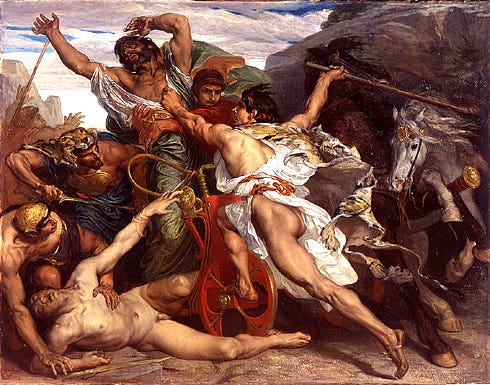
Tyranny and the Primal Father
In Totem and Taboo, Sigmund Freud introduced the myth of the Primal Father (Urvater) to explain the origins of social order, authority, and moral rules. In Freud’s narrative, early human society was organized around a dominant patriarch who monopolized power and control. The sons, excluded and subordinated, eventually unite to overthrow and kill this father figure in order to free themselves from his absolute authority.
Yet the act of rebellion does not bring the freedom they expected. According to Freud, the sons soon experience guilt and fear of renewed chaos. To restore order, they symbolically recreate the authority of the father they had destroyed. They establish new prohibitions, rituals, and institutions—what Freud described as totems and taboos—to regulate their behaviour and maintain social stability.
This produces a central paradox: the killing of the father does not eliminate authority. Instead, it reconstructs authority in a different form, embedding it within the rules and structures that govern the group. Patricide, in this sense, does not end power; it merely transforms and redistributes it.
In Freud’s account in Totem and Taboo, after the sons unite to kill the dominant “primal father” in order to free themselves from his authority, they are soon overwhelmed by guilt and fear that the chaos created by his absence could destroy the group. To restore order, they symbolically replace the father with a totem—often represented by an animal or sacred symbol that stands in for the slain patriarch. Around this totem they establish taboos, strict prohibitions that govern the community’s behavior, most importantly the bans against killing the totem and against sexual relations within the group (the incest taboo). These rules become the first moral and social laws of the community. In Freud’s interpretation, this moment marks the birth of religion, social order, and political authority: although the father has been killed, his power returns in symbolic form through the very rules and institutions the sons create to control themselves.
The Pattern of Rebellion
Modern rebellions across the Middle East often follow a pattern that echoes the psychological dynamic described by Freud. In many states of the region, authoritarian rule is not limited to a single leader; it is deeply intertwined with the state itself. Over decades, power structures have become embedded within security institutions, bureaucracies, economic networks, and political elites. As a result, the regime and the state often become indistinguishable. Removing the ruler does not easily dismantle only the regime—it risks unravelling the state that has been built around it.
This pattern has appeared repeatedly in recent history. In Iraq, the overthrow of Saddam Hussein did not simply remove a dictator; it shattered state institutions and triggered years of insurgency and sectarian conflict. Libya’s revolution ended Muammar Gaddafi’s rule but left a fractured state dominated by competing militias. Syria’s uprising, which began with calls for reform and freedom, descended into a prolonged civil war that devastated the country. Sudan has faced similar cycles of revolt followed by instability. Today, some observers fear that a comparable dynamic could emerge in Iran if the system were to collapse suddenly.
In each case, the rebellion begins as a struggle to overthrow a dominant “father-like” ruler or regime. It is framed as liberation from tyranny and the promise of a new political beginning. Yet when the father falls, the consequences often extend far beyond the removal of a single figure. Institutions collapse alongside the leader, administrative structures disintegrate, and security forces fragment.
The result is frequently not immediate freedom but fragmentation, civil war, or prolonged instability—illustrating how the fall of the ruler can also mean the collapse of the system that sustained the state itself.
The tragedy of many rebellions in the Middle East is that the act of overthrowing the “father” rarely ends the structures of domination that provoked the revolt in the first place. When authoritarian systems collapse, societies often discover that the very rules and hierarchies they sought to destroy were also holding the state together. In the absence of stable institutions, chaos, fragmentation, and insecurity quickly emerge.
At that point, revolutionary movements frequently confront an uncomfortable reality: to restore order, they must recreate many of the same mechanisms of authority that the fallen regime once used. New leaders impose rules, rebuild security structures, and centralize power in the name of stability. In doing so, the rebellion gradually reconstructs a familiar pattern of domination—often a new version of the same tyranny it sought to escape.
Freud’s metaphor of the primal father thus captures a deeper political cycle. The father is killed, but his authority returns in another form. What begins as an act of liberation risks becoming a repetition of the same structure of power, reminding us that destroying authority is far easier than building a political order capable of replacing it.
The Cycle of Political Patricide
Across much of the Middle East, political change risks falling into a recurring pattern that resembles the dynamic Freud described in Totem and Taboo. Long periods of authoritarian rule eventually generate deep frustration and rebellion. Uprisings emerge with the promise of liberation, aiming to overthrow the dominant “father” who symbolizes the regime. Yet when the rebellion succeeds—or even partially succeeds—it often weakens or destroys the institutions that held the state together.
The immediate aftermath is frequently marked by instability, fragmentation, or conflict, as competing forces struggle to fill the vacuum of authority. In such moments, societies facing insecurity and disorder often begin to search again for strong leadership capable of restoring stability. The result can be the emergence of another centralized authority—sometimes in the form of a new ruler, sometimes through powerful military or security structures.
The pattern thus risks repeating itself: authoritarian rule gives rise to rebellion; rebellion weakens or collapses the state; and the demand for order produces another authoritarian system. In this sense, the rebellion may succeed in killing the father, but the political system often reproduces another father in his place.
Iran offers perhaps the clearest illustration of this cycle. In 1979, a broad coalition of political forces overthrew the Shah and ended the monarchy that had ruled the country for decades, replacing it with the Islamic Republic under Ayatollah Ruhollah Khomeini. The revolution was widely celebrated as liberation from authoritarian rule and foreign influence. Yet the new system that emerged soon consolidated its own form of centralized religious authority and suppressed many of the political groups that had participated in the uprising. Today, decades later, some opponents of the Islamic Republic are once again calling for the restoration of the monarchy under the Shah’s son. In this sense, Iran reveals a striking pattern: the country moved from monarchy to theocratic rule, and now parts of the opposition look back to monarchy as a solution. The rebellion killed one father, replaced him with another, and now risks repeating the cycle yet again—illustrating how the politics of patricide can produce successive forms of authority rather than a genuine escape from them.
Is There a Way Out?
The central question that emerges from this pattern is whether the cycle is inevitable. Must rebellion always end by reproducing another form of domination, or is it possible to break the sequence of political patricide that has marked so many upheavals in the region?
The core challenge lies in institutions. Sustainable political change rarely comes simply from destroying authority; it requires building alternative structures capable of governing before the old system collapses. When revolutions focus only on removing the ruler while neglecting the slow work of institution-building, the vacuum that follows often invites the return of centralized power in a new form.
History repeatedly shows that negotiated and gradual transitions tend to produce more stable outcomes than abrupt collapses of the entire state apparatus. Where institutions survive and political actors bargain over reform, the risk of repeating authoritarian cycles is reduced. Where the system is destroyed without a viable replacement, the revolution often ends by reconstructing the very structures of power it sought to escape.
Whether the Middle East can move beyond this cycle remains an open question. Exploring possible paths out of it—particularly the role of non-violent and negotiated forms of political change—is a much larger subject that deserves its own discussion. I will return to this question in a future piece on Nonviolent Resistance (NVR) and negotiated transitions as potential alternatives to the destructive logic of political patricide.

How good it is to read an analysis of these current troubles that not only considers them with balance and moderation in their historical and regional dimensions, but also generates insight into the cycle of overthrow and restoration with the help of an imaginative schema such as Freud's.
"Whether the Middle East can move beyond this cycle remains an open question. Exploring possible paths out of it—particularly the role of non-violent and negotiated forms of political change—is a much larger subject that deserves its own discussion."
These remarks in the final paragraph are true enough, but this essay is a good reminder that exploring possible paths out of cycles of oppression and violence isn't only a question of analysing facts and judging what's feasible and what's fanciful.
Comprehension can also be helped by seeing that difficult things in human life need to be interpreted and engaged with imaginatively to make any sense of them at all. And interpreting afresh, even in an apparently far-flung way like Freud's, can sometimes open doors of understanding that, when walked through, make it possible to discuss reasonably and debate productively, instead of insisting on one's own fixed ideas.
As Theodor Adorno once put it "An der Psychoanalyse ist nichts wahr als ihre Übertreibungen." - In psychoanalysis only the exaggerations are true.
Very encouraging to see this combination of breadth, temperance and imagination being brought to bear on these difficult matters.