

Just weeks after the signing of the memorandum of understanding, disagreements began to surface and the framework started to unravel piece by piece—from southern Lebanon and the release of Iranian assets to the Strait of Hormuz. Washington appeared determined to strip away Iran’s bargaining leverage one element at a time in order to secure a more favourable position in future negotiations.
Ahead of the latest escalation, the United States sought to establish an alternative shipping corridor through Omani waters, reducing Iran’s ability to control maritime traffic through the Strait. Tehran, watching these developments closely, resisted and targeted vessels using the new route. Washington responded by launching a renewed military campaign—this time extending across Iran’s southern coastline in a broad arc from west to east.
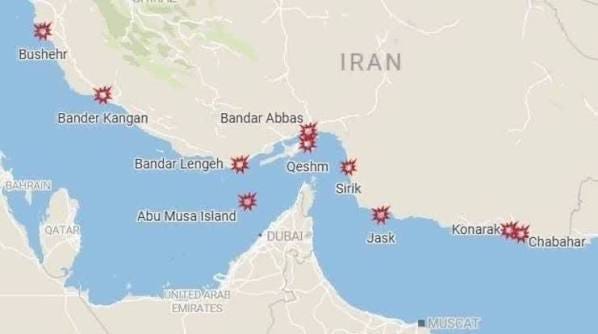
A Map of US Targets
The renewed US campaign against Iran appears to mark a shift from limited punitive strikes toward a broader effort to reshape the military balance in the country’s south. In recent days, American attacks have reportedly concentrated on Iran’s coastal and maritime infrastructure around Bandar Abbas, Jask, Chabahar, Bushehr, Abu Musa and Greater Tunb. The targets have included radar and surveillance facilities, coastal defence systems, missile and drone capabilities, command centres, naval assets and military logistics. Strikes have also reportedly hit bridges, rail links, electricity facilities and other infrastructure connecting Iran’s southern coast to the interior.
Taken together, this pattern suggests that Washington is no longer targeting isolated military assets alone. Instead, it appears to be degrading the wider system that enables Iran to monitor the Strait of Hormuz, move forces and equipment along its southern coastline, sustain its military logistics, and protect its maritime positions.
Yet weakening Iran’s operational capacity in Hormuz may be only the immediate objective. The scale, geographical spread, and selection of targets point to a campaign with broader strategic ambitions. The key question is therefore no longer what the United States is striking, but what political and military endgame these strikes are intended to achieve.
The following five scenarios explore the most plausible strategic objectives behind Washington’s renewed campaign and assess the opportunities, risks, and implications associated with each.
1. Neutralizing Iran’s Leverage Over the Strait of Hormuz
The most immediate and observable objective of the renewed US campaign appears to be reducing Iran’s ability to use the Strait of Hormuz as a strategic weapon. For decades, Tehran has compensated for its conventional military disadvantages by exploiting geography. Although it had repeatedly threatened to disrupt shipping, it had never needed to close the Strait completely. The mere ability to threaten commercial traffic was usually sufficient to influence global energy markets, raise insurance costs, and increase the strategic risks associated with any confrontation. Only during the recent war—when the Islamic Republic faced what it perceived as an existential threat—did Tehran move from deterrence to actively using this leverage.
Washington now appears determined to change that equation. Rather than accepting Iran’s dominant position on the Strait, the United States has sought to encourage commercial shipping to use a corridor closer to Omani waters, effectively moving vessels farther from Iranian territorial waters and military positions. Tehran quickly interpreted this as an attempt to erode one of its most valuable strategic assets and responded by targeting ships using the alternative route. The latest US military campaign followed shortly afterwards.
The pattern of American strikes supports this interpretation. The targets extended well beyond individual missile launchers to include radar and surveillance systems, command-and-control facilities, coastal defence positions, naval assets, transport infrastructure, and military logistics spread across Iran’s southern coastline. Taken together, these attacks appear designed to degrade the integrated network through which Iran monitors maritime traffic, deploys forces, sustains military operations, and threatens vessels transiting the Strait.
If successful, such a strategy would gradually reshape the strategic geography of Hormuz. Instead of relying on shipping lanes running close to Iranian waters, commercial traffic could increasingly use routes where Tehran’s capacity to interfere is significantly reduced. Iran would remain geographically adjacent to the Strait, but its ability to translate geography into political and military leverage would be substantially weakened.
The implications extend well beyond maritime security. Control over the Strait of Hormuz has long been one of Tehran’s strongest bargaining cards in its dealings with the United States and the wider international community. Reducing that leverage would strengthen Washington’s negotiating position by depriving Iran of one of its most effective instruments of coercion. In that sense, the campaign may be aimed as much at reshaping the political value of Hormuz as at securing freedom of navigation.
Whether this objective can ultimately be achieved remains uncertain. Geography cannot be changed, and Iran retains numerous asymmetric capabilities beyond its southern coastline. Nevertheless, if Washington intends to pursue any of the more ambitious scenarios discussed below, reducing Tehran’s leverage over the Strait would be a logical first step. It would provide the operational foundation upon which the rest of the campaign could be built.
2. Fighting an Attrition War to Improve Washington’s Bargaining Position
A second possibility is that Washington is not seeking a decisive military victory at all, but a prolonged campaign designed to steadily reduce Iran’s room for manoeuvre. In this scenario, the purpose of the strikes is not regime change, but coercive diplomacy: applying enough military, economic, and social pressure to force Tehran back to negotiations from a weaker position.
Once pressure in the Strait is established, the United States can widen the cost of confrontation without necessarily escalating to full-scale war. Repeated strikes on coastal military infrastructure, logistics, transport routes, and energy-related facilities would make it more difficult and expensive for Iran to sustain its southern front. At the same time, disruption to shipping and trade would add pressure to an economy already strained by sanctions, capital shortages, and declining public confidence.
The logic is cumulative. Each individual strike may have limited strategic effect, but over time the combined damage can erode military readiness, reduce export capacity, increase insurance and transport costs, and deepen domestic economic hardship. The burden would not fall only on the state. Shortages, inflation, unemployment, and declining public services could gradually increase social pressure on the leadership.
This is where the strategy differs from a direct attempt to overthrow the Islamic Republic. Washington may calculate that regime change is too unpredictable, costly, and dangerous, while sustained attrition offers a more controlled way to influence Tehran’s choices. The aim would be to convince Iranian leaders that continuing the confrontation is more costly than accepting a revised agreement.
In that sense, the battlefield becomes an extension of the negotiating table. Military pressure is used not to eliminate the adversary, but to change its calculation of costs and benefits. Washington would seek to remove Iran’s strongest bargaining cards one by one—first its leverage over Hormuz, then its access to revenue and strategic infrastructure—until Tehran concludes that returning to negotiations is the least damaging option.
The difficulty is that attrition works in both directions. Iran has its own capacity to impose economic, military, and political costs on the United States and its regional partners. A prolonged campaign could therefore produce escalation rather than compliance, harden nationalist sentiment, and make compromise more politically difficult in Tehran.
3. Creating an Internal Front Through Proxy Forces
A third—and more controversial—scenario is that the military campaign is intended to create the conditions for a sustained internal conflict by encouraging armed opposition groups operating along Iran’s periphery. If maritime pressure weakens Tehran’s ability to project force externally, a parallel internal front could further stretch the state’s military and security resources.
Iran’s border regions have long hosted armed groups with varying degrees of separatist, ethnic, or ideological agendas. In the southeast, Baluch insurgent organizations have periodically carried out attacks against Iranian security forces. In the southwest, some Arab separatist organizations in Khuzestan have also challenged the Iranian state, although their operational capacity has generally remained limited. Additionally, in the northwest, several Kurdish armed groups continue to maintain bases across the Iraqi border and have a long history of confrontation with Tehran.
None of these groups currently poses an existential threat to the Islamic Republic on its own. However, if they were to receive greater intelligence, financial, logistical, or political support while Iran remained under sustained military pressure, they could significantly complicate Tehran’s security calculations. Instead of concentrating resources on confronting the United States in the Gulf, Iran would be forced to divide its military attention between external operations and multiple internal fronts.
Such an approach would not be unprecedented. Throughout modern military history, external military pressure has frequently been combined with support for local insurgencies as part of a broader strategy of irregular warfare. Rather than relying solely on conventional military superiority, states have often sought to exploit existing internal fractures to increase the costs of resistance and gradually erode an adversary’s capacity to govern contested territory.
At the same time, this scenario carries considerable risks. History suggests that external support for insurgent movements rarely remains confined to its original objectives. Such conflicts often become prolonged, difficult to control, and capable of producing wider regional instability. Iran’s ethnic borderlands are closely connected to neighbouring states—including Pakistan, Iraq, Turkey, and the Gulf—which means that a localized insurgency could quickly acquire broader regional dimensions.
For that reason, opening an internal front would represent a significant escalation. While it could increase pressure on Tehran, it would also transform the conflict from a conventional interstate confrontation into a prolonged hybrid war whose consequences would extend well beyond Iran itself.
4. Seizing Kharg Island to Disrupt Iran’s Oil Exports
A fourth—and far more escalatory—scenario is that the current campaign is laying the groundwork for the seizure or neutralization of Kharg Island, the heart of Iran’s oil export infrastructure. Unlike the previous scenarios, which focus primarily on military pressure and coercive diplomacy, this option would strike directly at the economic foundation of the Islamic Republic.
Kharg Island is arguably Iran’s single most strategic economic asset. Located in the northern Gulf, it handles more than 90 percent of the country’s crude oil exports. Although Iran possesses large oil reserves across several provinces, without Kharg its ability to export them at scale would be severely constrained. In strategic terms, Kharg is to Iran’s economy what the Strait of Hormuz is to its geopolitical leverage.
From Washington’s perspective, seizing—or even rendering the island inoperable—would fundamentally alter the balance of the conflict. Rather than relying primarily on sanctions, the United States would acquire direct leverage over Iran’s principal source of foreign currency. Control over Kharg could become a powerful bargaining chip in future negotiations, allowing Washington to link the restoration of Iran’s export capacity to broader political and security concessions.
Such a move would also reinforce the logic behind the current operations in southern Iran. The systematic targeting of coastal air defences, missile batteries, naval assets, logistics networks, and command centres could be interpreted not only as an effort to secure maritime navigation but also as preparations for protecting any future operation in the northern Gulf. In military planning, degrading an adversary’s anti-access and area-denial capabilities is often a prerequisite for conducting more ambitious operations.
Yet this scenario would also represent a dramatic escalation. Unlike strikes on military infrastructure, the occupation or prolonged denial of Kharg would directly target the backbone of Iran’s economy. Tehran would almost certainly regard such an operation as an attempt to strangle the state financially rather than merely alter its military behaviour. The pressure for retaliation would increase significantly, raising the likelihood of wider attacks against Gulf energy infrastructure, regional shipping, and American interests across the Middle East.
The consequences would extend well beyond Iran. Removing the export terminal responsible for the overwhelming majority of Iranian oil exports would tighten global energy supplies, increase volatility in international markets, and place additional pressure on major oil-importing economies. Even if other producers attempted to compensate, markets would likely react sharply to the prospect of prolonged disruption in one of the world’s most important energy corridors.
Whether Washington is prepared to take such a risk remains uncertain. Nevertheless, if the objective is to deprive Tehran of its most valuable sources of leverage before negotiations resume, Kharg Island represents one of the few targets whose strategic value rivals that of the Strait of Hormuz itself.
5. Preparing the Battlespace for a Limited Ground Operation
The fifth and most ambitious scenario is that the strikes across southern Iran are intended to prepare the battlespace for a limited ground operation. This remains the least likely of the five possibilities, particularly given the enormous political and military costs associated with deploying American forces on Iranian territory. Yet the geographical concentration and selection of targets make it difficult to dismiss the scenario entirely.
Any operation across the Gulf would likely begin as an amphibious assault rather than a conventional land invasion. US forces would need to cross from bases or naval platforms on the Arab side of the Gulf, secure a section of Iran’s coastline, and establish one or more beachheads through which personnel, vehicles, fuel, ammunition, and air-defence systems could be brought ashore. Even a geographically limited mission would therefore require extensive preparation and sustained control of the surrounding sea and airspace.
The latest targets are relevant in this context. Strikes on coastal surveillance networks, missile and drone sites, air defences, naval assets, command centres, bridges, rail links, and logistics infrastructure could weaken Iran’s ability to detect an approaching force, contest a landing, or rapidly reinforce the southern coastline from the interior. Attacks stretching from Bushehr and Bandar Abbas to Jask and Chabahar may be intended to create operational uncertainty across a broad front, preventing Tehran from concentrating its defences around a single possible landing area.
Southern Iran offers several potential objectives for a limited operation. These could include securing islands or coastal facilities, temporarily occupying a port, establishing control over strategic energy infrastructure, or creating a buffer around shipping routes. Such an operation would not necessarily seek to conquer Iran or march toward Tehran. Its purpose could instead be to seize a limited but strategically valuable area and use it as leverage in negotiations.
Yet securing a beachhead would be only the beginning. The greater challenge would be sustaining it. Iran’s coastline is backed by difficult terrain, long supply routes, major population centres, and military forces capable of irregular resistance. A supposedly limited operation could quickly expand if Iranian forces attacked supply lines, if local resistance developed, or if Washington felt compelled to push farther inland to protect its initial position. The experience of previous Middle Eastern wars demonstrates how easily a narrowly defined mission can produce broader and more enduring commitments.
The political risks would be equally severe. The presence of foreign troops on Iranian soil could strengthen nationalist support for the state and reduce internal divisions. It could also provoke wider retaliation against American bases and allied states across the region.
For that reason, A ground operation remains unlikely today, but the logic of military planning means that Washington may still be shaping the battlefield so that such an option exists tomorrow. The present attacks may be preparing an option rather than signalling a decision.
Bottom Line
The renewed US campaign against Iran should not be understood through a single objective. Modern wars often pursue several political and military goals at once: degrading an adversary’s immediate capabilities, reshaping the strategic environment, strengthening negotiating leverage, and preserving options that may never ultimately be used.
These five scenarios are therefore not mutually exclusive. Neutralizing Iran’s leverage over the Strait of Hormuz could support a wider war of attrition. Pressure on the southern coastline could also prepare the conditions for operations against Kharg Island, enable support for internal armed groups, or preserve the option of a limited ground intervention. Each scenario may function as both an objective in itself and a means toward a broader political end.
The most likely near-term purpose remains coercive diplomacy rather than outright regime change. Washington appears to be trying to remove Iran’s bargaining cards one by one, increase the costs of continued resistance, and force Tehran back to negotiations from a weaker position. Yet the danger is that a strategy designed to produce concessions may instead create a cycle of escalation in which both sides continually expand the conflict to recover lost leverage.
The central question, then, is not simply what the United States is targeting, but which outcome it ultimately considers sufficient. Until Washington defines the political settlement it is prepared to accept, military success may continue to widen the battlefield without bringing the war any closer to an end.
