

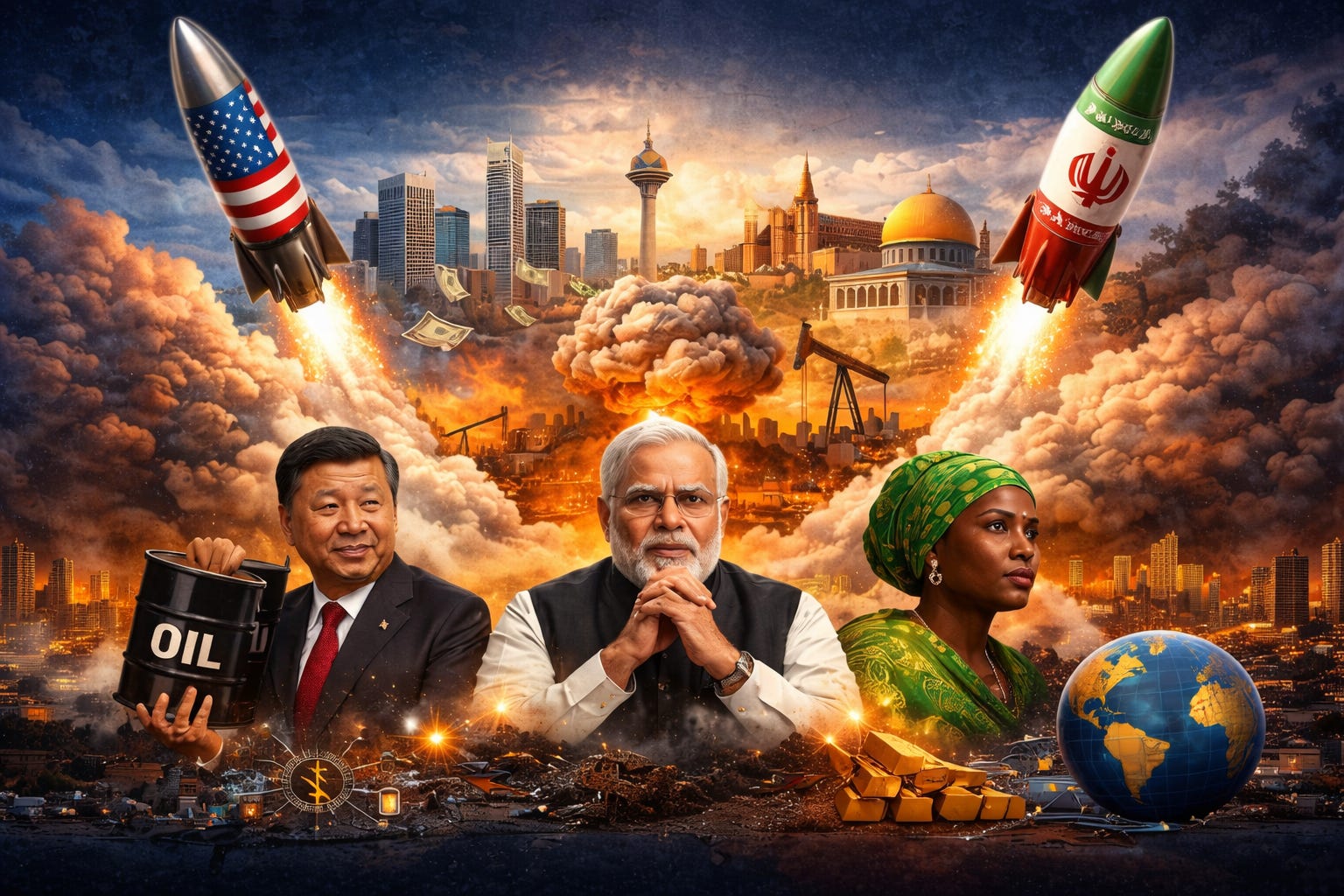
A War Beyond the Middle East
The US–Israel war on Iran should not be understood as a purely regional conflict. It is unfolding within a broader landscape of intensifying global power competition, where the United States and its allies are increasingly confronting China, Russia, and a range of rising actors across the Global South. The war reflects a wider pattern of pressure and contestation, from actions in Latin America, including moves against Venezuela and threats toward Cuba, to economic confrontation with China and ongoing tensions with Russia.
In this context, the Global South is far from a passive observer. It is economically exposed to energy shocks, politically engaged in global alignments, and strategically affected by shifting power balances. Decisions made in Washington, Tehran, or Tel Aviv are already reverberating across Africa, Asia, and Latin America, through markets, diplomacy, and security calculations.
The core argument of this article is that the outcome of this war will extend far beyond the battlefield. It will reshape how Global South states understand sovereignty, security, economic independence, and international alignment in an increasingly multipolar world, where reliance on a single global power is no longer seen as either stable or sufficient.
Nuclear Sovereignty
The Iran case brings a fundamental question back to the center of global politics: do Global South states have the right to nuclear technology, including enrichment? Across much of the Global South, the issue is no longer seen purely through the lens of non-proliferation, but as one of technological sovereignty and unequal power. Nuclear capabilities appear to be governed by selective rules, permitted for some states while restricted or punished in others.
The current war introduces a dual, and contradictory, dynamic.
On one hand, the attack on Iran sends a powerful signal that even negotiated states can be targeted, reinforcing the belief that compliance does not guarantee security. This perception is likely to encourage countries with existing nuclear infrastructure, such as Brazil and others, to consider moving closer to latent or actual nuclear deterrence, seeing it as the ultimate guarantee of sovereignty and survival.
On the other hand, if Iran were to be significantly weakened or defeated, it could establish a new precedent: that states approaching the nuclear threshold will be stopped before reaching it. Such an outcome would reinforce a stricter global order aimed at preventing enrichment capabilities from ever translating into strategic leverage.
This creates a double-edged dynamic. The same war that incentivises some Global South states to pursue nuclear capability as protection may simultaneously strengthen a system designed to deny them that very possibility. The result is a more unstable and contested nuclear order, where the line between deterrence and prohibition becomes increasingly blurred.
Economic Independence vs. Structural Dependency
The war is exposing a central vulnerability across the Global South: deep structural dependence on global systems they do not control. As conflict disrupts energy flows and trade routes, many countries are already feeling the consequences through energy price shocks, rising inflation, and supply chain disruptions. For economies with limited buffers, these external shocks quickly translate into domestic instability.
In this context, Iran presents a controversial but instructive case. Decades of sanctions have forced it to develop a model of economic survival under pressure, reducing dependence on Western systems, building parallel trade and financial networks, and adapting to constraints through domestic production and alternative partnerships. While costly and imperfect, this model has demonstrated a degree of resilience that is increasingly attracting attention in parts of the Global South.
The broader shift now underway is a growing interest in economic self-reliance and diversification away from Western-dominated systems. This includes efforts to trade in non-dollar currencies, expand South–South economic ties, and reduce exposure to sanctions-based pressure.
Recent U.S. economic policies have further accelerated this shift. The extensive use of sanctions, tariffs, and coercive economic measures, alongside increasingly transactional and at times humiliating treatment of partners, has raised concerns about the reliability of the existing global economic order. The perceived selective application, or disregard, of international law has reinforced these anxieties. As a result, many countries, not only in the Global South but also among U.S. allies in Europe, are increasingly seeking to diversify their partnerships and reduce strategic dependence, investing more seriously in economic self-reliance and alternative networks to hedge against future pressure.
At the same time, the war highlights a deeper structural issue: the monopoly of advanced technologies, from global finance systems to artificial intelligence and energy infrastructure, remains largely concentrated in the West. This imbalance reinforces dependency and limits the strategic autonomy of Global South states.
As a result, there is a growing push toward alternative technological and economic ecosystems, often led or supported by China and, to a lesser extent, Russia. Whether through digital infrastructure, payment systems, or energy cooperation, these alternatives are increasingly seen not just as economic options, but as tools for strategic independence in an uncertain global order.
Security Lessons: The Failure of International Guarantees
One of the clearest lessons emerging from the war is that international law and negotiated agreements do not necessarily guarantee protection. For many states in the Global South, this reinforces a long-standing concern: that the global security architecture is unevenly applied and politically contingent.
The Iran case is particularly instructive. Despite entering into a negotiated agreement and engaging in diplomatic processes, Iran has still become the target of military action. This sequence sends a powerful message to other states: compliance and negotiation do not ensure security if geopolitical interests shift.
The implication is a growing move toward self-help security models. Rather than relying on international guarantees or external protection, states are increasingly investing in their own deterrent capabilities. This includes missile programs, drone warfare, cyber capabilities, and other forms of asymmetric power that can raise the cost of external intervention.
This shift also reflects a broader erosion of trust in Western-led security frameworks, which are now often perceived as selective in both enforcement and protection. As a result, many countries in the Global South are recalibrating their security strategies, not around international norms alone, but around credible deterrence and strategic autonomy.
The key question going forward is whether this moment marks a temporary crisis of confidence, or a more permanent turning point: the gradual decline of trust in global security guarantees and the rise of a more fragmented, self-reliant security order.
The Rise of Alternative Alliances
The war is accelerating a set of trends that were already underway across the Global South, pushing many states to rethink their alliances and reduce dependence on Western-centered systems. Among the most visible shifts is the growing momentum behind de-dollarisation, as countries seek to conduct trade in alternative currencies to shield themselves from financial pressure and sanctions. At the same time, the expansion of BRICS+ and the deepening of South–South cooperation reflect a broader effort to build parallel economic and political platforms.
In this emerging landscape, China has positioned itself as a central economic anchor, both as the largest trading partner for many Global South countries and as a provider of infrastructure, investment, and alternative financial mechanisms. Beijing has also increasingly taken on a diplomatic mediation role, presenting itself as a stabilising actor capable of engaging with all sides.
Russia, meanwhile, continues to play a complementary role as a security partner and energy coordinator, particularly through frameworks like OPEC+ and its expanding defense ties with a number of states in the Global South.
Faced with these options, many countries are not choosing full alignment with any single power. Instead, they are adopting a strategy of balancing rather than aligning, seeking to maximise autonomy by engaging multiple partners simultaneously.
The long-term implication is the possible emergence of new security and economic blocs operating partially outside Western control. While these blocs may remain fluid and loosely structured, they signal a gradual shift toward a more multipolar order, in which the Global South is not just a participant, but an active architect of alternative global arrangements.
The Legitimacy Crisis of the Global Order
The war is deepening a growing perception across the Global South that the current international order is neither neutral nor consistently rules-based. Instead, it appears increasingly shaped by selective application of international law and uneven respect for sovereignty, depending on geopolitical alignment rather than universal principles.
This perception is not new, but the present conflict has reinforced it in a highly visible way. When rules seem to apply differently to different actors, the credibility of the system itself comes into question. For many in the Global South, this raises a fundamental concern: whether international norms are binding frameworks or simply flexible tools of power.
The result is a gradual but significant erosion of trust in Western-led institutions, including diplomatic, legal, and financial systems that have long underpinned the global order. At the same time, this environment is strengthening anti-hegemonic narratives, which argue that the current system is designed to preserve the dominance of a small group of powerful states rather than ensure fairness or stability.
Increasingly, countries in the Global South are beginning to view the global order not as a genuinely rules-based system, but as a hierarchical structure, where power determines outcomes more than law. This shift in perception is critical, as it shapes how states engage with international institutions, form alliances, and define their own strategic futures in an evolving multipolar world.
Iran and the Strategic Empowerment of the Global South
Beyond its immediate military objectives, Iran is also using the war as an opportunity to reshape its role within the Global South, positioning itself not only as a resisting state, but as a provider of strategic leverage to selected partners.
One clear example is the management of the Strait of Hormuz. Rather than a total and indiscriminate closure, Iran has adopted a selective approach, allowing passage for countries it considers neutral or friendly. Reports indicate that India and China have been granted access, even in periods of disruption, while access for adversaries has been restricted . This selective opening reflects a deliberate strategy: to reward Global South partners and reinforce alternative economic networks, even among countries like India that maintain close ties with Israel and the United States. 
This approach transforms control over energy routes into a geopolitical tool of alignment, strengthening ties with emerging powers while challenging Western dominance over global trade flows.
At the same time, China and Russia are broadly aligned with Iran’s resistance, seeing in this conflict an opportunity to accelerate a shift in global power. While neither has engaged directly in combat, both have provided varying degrees of intelligence, logistical, and material support, helping Iran sustain its defensive capacity without triggering full-scale escalation . In parallel, economic cooperation, particularly in energy and alternative financial systems, continues to deepen, reinforcing a shared interest in weakening Western leverage.
For China, the conflict also reinforces long-term strategic goals, including reducing dependence on Western-controlled energy systems and potentially expanding alternatives such as non-dollar energy trade . Russia, meanwhile, benefits from shifts in global energy markets and the weakening of Western influence.
Taken together, these dynamics suggest that Iran is not only defending itself, it is actively contributing to a broader realignment within the Global South. By leveraging geography, energy, and strategic partnerships, Tehran is helping to shape a moment where resistance to Western pressure becomes a shared political and economic project, with implications that extend far beyond the Middle East.
Bottom Line: A Turning Point for the Global South
The Iran war is not just another conflict in the Middle East, it is a structural moment with far-reaching consequences for the global order. It is reshaping how states, particularly in the Global South, understand power, survival, sovereignty, and autonomy in an increasingly contested international system.
At its core, the war presents two contrasting scenarios with global implications.
If Iran were to collapse or be forced into surrender, it would likely reinforce U.S. hegemony and send a clear signal that resistance to the current global order carries overwhelming costs. Such an outcome would strengthen deterrence against other Global South states seeking strategic autonomy, particularly in areas like nuclear capability, independent foreign policy, or economic divergence from Western systems. In this scenario, the message would be clear: the limits of autonomy are defined by dominant powers.
Alternatively, if Iran resists and survives, the implications could be very different. It would demonstrate that sustained resistance, even under intense military and economic pressure, is possible. This outcome would likely empower Global South states, reinforcing trends toward strategic independence, diversified alliances, and the pursuit of self-reliance in security and economic policy. It would also accelerate the shift toward a more multipolar world, where power is more distributed and contested.
The key question, therefore, is not only about the outcome of the war itself, but about its broader legacy: Will the Global South move toward a more unified and independent geopolitical identity, or remain fragmented within competing power blocs shaped by external forces?

Nice to read an analysis focusing on geography that doesn't just point out the obvious (geography matters), but considers classic geostrategic elements such as Hormuz in connection with macro-regional political and alliance shifts.
BRICS+ is looking pretty good at the moment.