

From a Local Crisis to a Global Narrative
The recent migration surge into the Spanish enclave of Ceuta was, in many respects, a familiar episode. Similar crises have occurred repeatedly over the past two decades, reflecting the unresolved dispute between Spain and Morocco over Ceuta and Melilla, as well as broader regional tensions surrounding Western Sahara. Spain’s support for the Sahrawi cause and its growing relationship with Algeria—Morocco’s principal regional rival—have repeatedly strained relations with Rabat. Whenever these tensions intensify, migration has frequently become a source of political pressure. In previous episodes, footage has shown Moroccan security forces allowing—or at least not preventing—large numbers of migrants from crossing into the Spanish enclave. The latest incident also came only days after Spain and Algeria agreed to launch a new phase in their bilateral relations by holding their eighth High-Level Meeting in October, adding another layer to an already complex regional context.
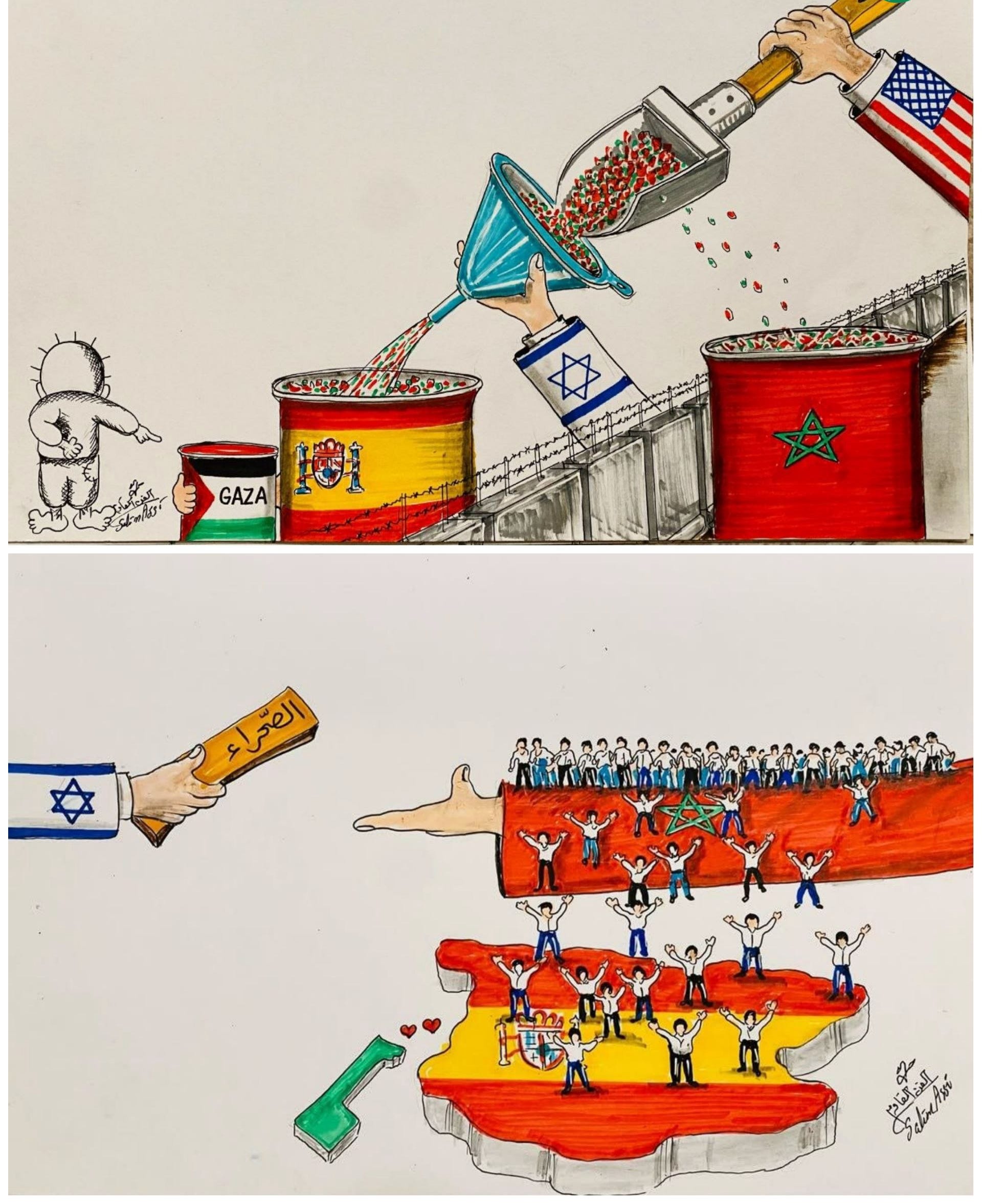
The immediate crisis was relatively limited. Spanish authorities quickly regained control, and many migrants soon began returning to Morocco. Yet on social media, the episode rapidly evolved far beyond a local border dispute. Israeli officials and pro-Israel accounts linked the incident to Spain’s criticism of Israel over Gaza, questioning Madrid’s moral authority to criticise Israeli security policies. At the same time, a segment of the MAGA movement that remains loyal to Donald Trump presented the episode as evidence of the dangers of Europe’s immigration policies and as validation of Trump’s own border agenda. This came after a significant portion of the MAGA movement had become increasingly critical of Trump over the war with Iran and his unwavering support for Israel’s military campaigns in Gaza, Lebanon and the wider region. As a result, the discussion quickly expanded beyond Ceuta itself, becoming increasingly framed through the lenses of immigration, Islamophobia and civilisational conflict—narratives that served different political purposes in both the Israeli and American contexts.
Shifting the Conversation from Gaza to Europe: Constructing a Counter-Narrative
The Ceuta migration crisis quickly became more than a debate about Spain’s border policy. It also provided an opportunity to redirect attention from Gaza toward Spain itself. Israeli officials increasingly questioned Spain’s own credibility on issues of sovereignty, migration and colonialism. In doing so, the focus shifted from Israel’s actions to Spain’s perceived vulnerabilities.
The timing is significant. Since the outbreak of the Gaza war, Spain has emerged as one of Israel’s most outspoken European critics. Madrid has recognised the State of Palestine, imposed a national arms embargo on Israel, permanently withdrawn its ambassador, and urged the European Union to reconsider its broader partnership with Israel. These measures have made Spain one of the principal European targets of Israeli diplomatic criticism.
Israeli officials have increasingly framed Spain’s domestic challenges as evidence of political hypocrisy. Responding to the Ceuta crisis, Israel’s Ambassador to the United Nations argued that “Spain, which never misses an opportunity to lecture Israel,” should first explain why it continues to administer “colonial enclaves in Africa.”
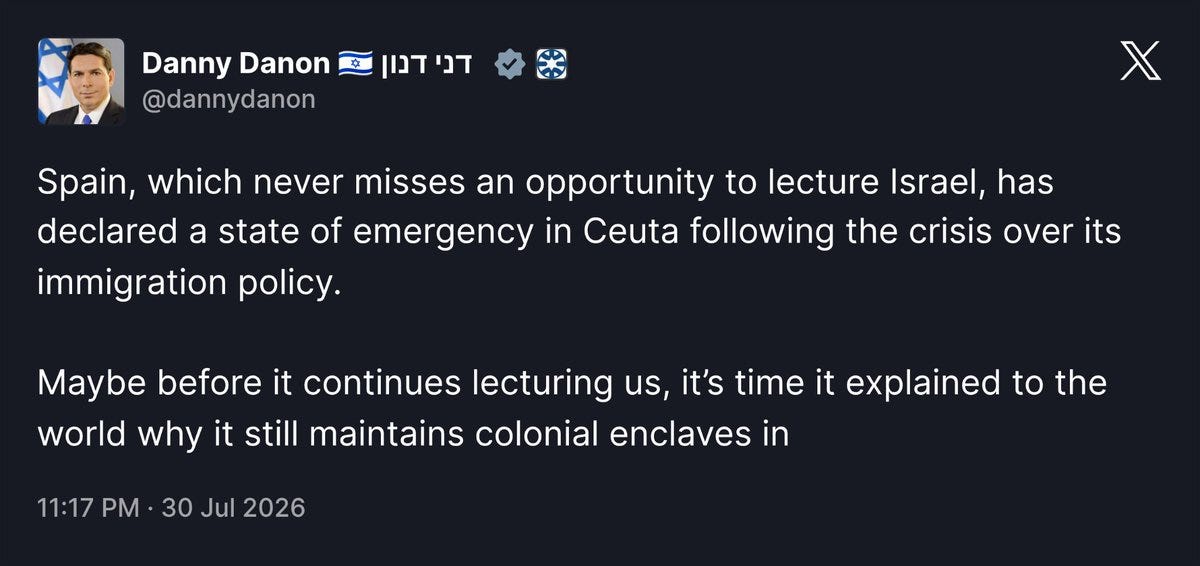
Similar arguments have repeatedly appeared in the rhetoric of Prime Minister Benjamin Netanyahu’s son, Yair Netanyahu. In one post, he criticised Spain for allegedly supporting organisations opposed to Israeli settlements while asking Madrid to stop supporting groups that challenge Israel’s claims over the West Bank. In another, he published a map of Spain’s North African territories with the message: “Dear Arabs and Muslims. Want to free occupied Arab and Islamic lands? Here’s a good start.”


These remarks are consistent with a broader pattern of Israeli diplomatic messaging. Last April, Prime Minister Benjamin Netanyahu warned that he would not allow any country to “wage a diplomatic war” against Israel without “paying an immediate price.” Whether or not the Ceuta episode formed part of a deliberate communication strategy, the migration crisis rapidly became another platform through which Israeli officials challenged Spain’s moral authority and redirected international attention away from Gaza and toward Europe’s own political and border disputes.
More importantly, the episode illustrates how modern information warfare increasingly relies on constructing competing narratives rather than simply rebutting criticism. In this case, two parallel narratives emerged. The first sought to portray Israel’s security policies as a necessary response to the same civilisational challenge that Europe now faces through irregular migration, implicitly arguing that what Israel is doing today is what European states may eventually have to do themselves. The second reframed Spain not as a credible critic of Israel, but as a country struggling with its own unresolved border disputes, migration pressures and colonial legacies. Together, these narratives do not seek to deny criticism of Israel; they seek to redefine the terms of the debate by shifting public attention from Gaza to Europe’s own insecurities.
Why Did Suspicion Fall on Israel?
The rapid politicisation of the Ceuta crisis also generated speculation about whether Israel had played any role beyond the information campaign that followed. The episode triggered intense online debate because it coincided with a series of earlier proposals arguing that Israel should use Morocco’s territorial claims to pressure Spain over its support for Palestine.
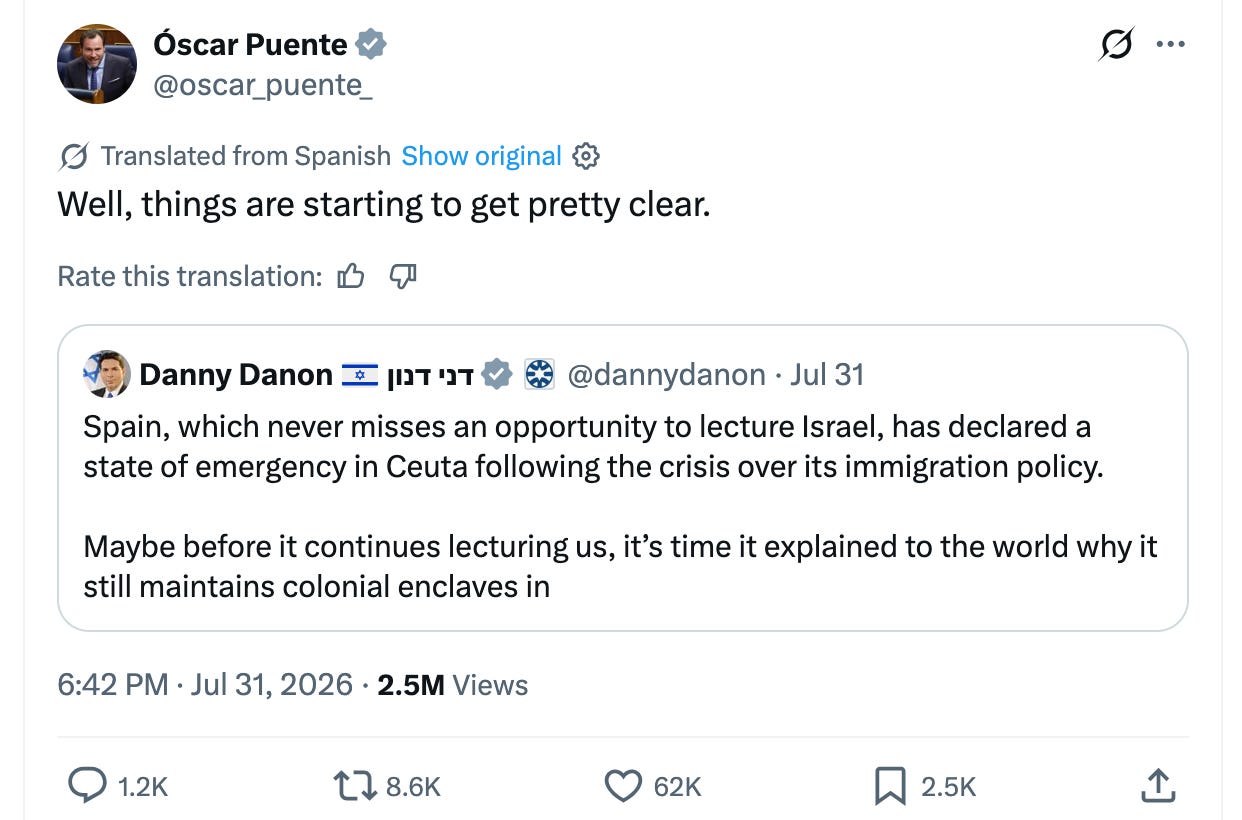
One of the strongest reactions came from Spain’s Minister of Transport, Óscar Puente, who responded to the Israeli ambassador to the United Nations’ comments by writing on X: “Well, things are starting to get pretty clear.” His remark reflected a broader suspicion circulating on social media that the migration crisis was being politically exploited against Spain.
That suspicion was reinforced by several articles published months before the crisis. In March, Michael Rubin of the American Enterprise Institute argued that Morocco should organise a new “Green March” into Ceuta and Melilla, suggesting that civilians enter the enclaves peacefully while raising Moroccan flags to expose what he described as Spain’s anti-colonial hypocrisy. A month later, writing for the Israeli outlet *Ynet*, Middle East Forum fellow Amine Ayoub proposed that Israel should support Morocco’s claims over Ceuta and Melilla as a way of punishing Spain for recognising Palestine and challenging both American and Israeli policies. Ayoub outlined three possible avenues: direct diplomatic backing for Morocco, lobbying through Washington, and repeatedly portraying Spain as hypocritical over questions of occupation and sovereignty.
The resurfacing of these articles immediately after the migration crisis intensified online speculation. Commentators noted that proposals advocating support for Morocco had appeared months before thousands of migrants crossed into Ceuta. Others revived a 2019 post by Yair Netanyahu calling on Arabs and Muslims to “free” Ceuta and Melilla, arguing that the latest events appeared consistent with earlier rhetoric directed at Spain.
The speculation has also been reinforced by reports that Morocco was among several countries discussed in proposals for relocating Palestinians from Gaza following the October 7 attacks, a plan widely criticised by human rights organisations and many governments as amounting to ethnic cleansing, further intertwining Rabat’s relationship with Israel in the eyes of many observers.
Reviving MAGA Around Trump
The Ceuta crisis also resonated strongly within the segment of the MAGA movement that remains loyal to President Donald Trump. This came at a politically significant moment. In recent months, divisions had emerged within the movement over Trump’s handling of the war with Iran and his unwavering support for Israel’s military campaigns in Gaza, Lebanon and the wider Middle East. For many critics within MAGA, foreign intervention had begun to overshadow the movement’s traditional priorities of border security and domestic politics.
The migration crisis in Spain helped shift that conversation. Rather than focusing on the Middle East, Trump’s allies reframed the debate around one of the issues that has long unified the movement: immigration. In doing so, a distant border incident in Europe became evidence that Trump’s warnings about uncontrolled migration and national sovereignty were not uniquely American but part of a broader Western challenge.
Trump himself quickly seized on the episode. Speaking at Camp David, he described the events in Spain as “an invasion of a country by hundreds of thousands of people” and warned that the United States would face an even greater crisis if Republicans failed to retain power. His administration followed with an unusually coordinated messaging campaign. The State Department blamed Spain’s government for “deliberate efforts to enable and facilitate mass illegal migration into Europe” and indicated that Washington was considering measures to assist European allies confronting similar challenges.
Other senior officials reinforced the same message. Vice President JD Vance described the scenes from Ceuta as evidence of “radical left-wing globalist policies that have enabled the invasion of the West.” White House Deputy Chief of Staff Stephen Miller argued that the crisis demonstrated the consequences of permissive immigration policies, while Secretary of State Marco Rubio declared that the incident represented “an egregious violation” of Spain’s sovereignty and publicly criticised Madrid’s handling of migration.
Taken together, these statements illustrate how quickly a local border dispute in North Africa was incorporated into America’s domestic political debate. The episode became more than a discussion about Spain; it was transformed into a powerful symbol reinforcing Trump’s long-standing narrative on immigration, borders and national sovereignty. At a time when foreign policy had become an increasingly divisive issue within MAGA, the Ceuta crisis helped redirect attention toward an issue that has historically unified the movement and remains central to Trump’s political identity.
The result was a convergence of narratives on both sides of the Atlantic. While Israeli officials used the crisis to challenge European criticism of Israel and reframe the debate around security and migration, Trump’s allies employed the same images to revive familiar arguments about illegal immigration and Western decline. A local migration incident thus became a shared communication asset serving different political objectives in Israel and the United States, demonstrating how modern information warfare increasingly repurposes the same event for multiple audiences and strategic goals.
Redirecting the Far Right’s From Anti-Israel to Anti-Muslim Narratives
One of the less discussed consequences of the Ceuta crisis is its potential impact on divisions within the American and European right. Over the past two years, prominent conservative and far-right figures—including Tucker Carlson, Steve Bannon, Candace Owens and Nick Fuentes—have become increasingly critical of Israel’s conduct in Gaza. Although they differ significantly in ideology and influence, they have shared concerns over Washington’s unconditional support for Israel, with some questioning whether Israel continues to serve American strategic interests.
The migration crisis in Spain provided an opportunity to redirect that conversation. Rather than focusing on Gaza or Israel’s military campaign, the debate shifted back to one of the defining themes of right-wing politics: immigration. Images of large numbers of migrants crossing into Ceuta, combined with narratives portraying Europe as facing an existential civilisational challenge, reactivated an issue around which many conservatives and far-right movements have historically found common ground.
This shift also blurred the distinction between two separate debates. Criticism of Israel’s policies in Gaza increasingly gave way to renewed attention on migration, border security and Islam. The result was not necessarily the disappearance of anti-Israel sentiment within sections of the right, but its displacement by a more immediate and emotionally resonant narrative centred on Muslim migration and national identity.
For Israel, such a shift carries an obvious strategic advantage. The less public debate focuses on Gaza and Israeli policy, and the more it centres on immigration and the perceived threat posed by Muslim communities, the easier it becomes to frame Israel’s conflict as part of the same broader struggle confronting Western societies. In that sense, migration narratives do more than influence domestic politics; they also reshape the international political environment in ways that can indirectly reduce pressure on Israel while redirecting public frustration toward a different target.
Amplifying Islamophobia
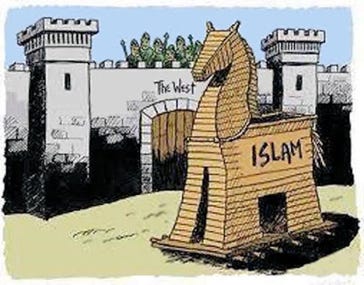
The European and American far right pushed the narrative a step further by transforming a local migration incident into evidence of a broader civilisational conflict between Islam and the West. In doing so, the discussion moved beyond border security and became increasingly framed through the language of cultural survival, demographic replacement and national decline.
Prominent right-wing figures quickly amplified this interpretation. Elon Musk shared a scene from a zombie film with the comment, “Wow, the situation in Spain looks crazy!”—invoking imagery that portrayed migrants not as individuals but as an overwhelming and uncontrollable force.


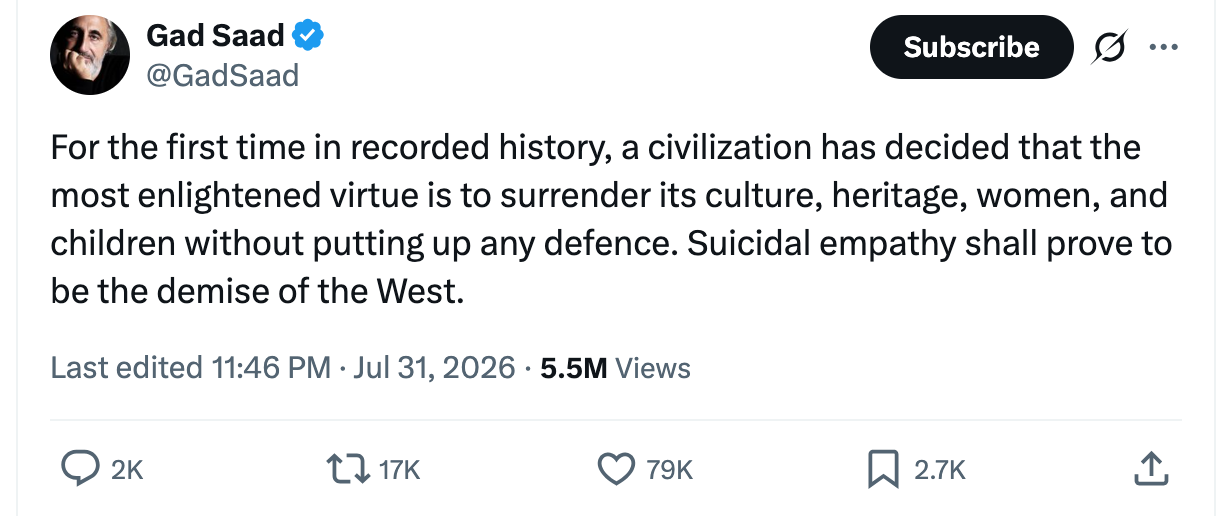
Canadian psychologist and commentator Gad Saad described the events as proof that Western civilisation had chosen to surrender “its culture, heritage, women, and children” through what he called “suicidal empathy,” arguing that such attitudes would ultimately lead to the West’s demise.
European political leaders echoed similar themes. Alice Weidel, co-leader of Germany’s Alternative for Germany (AfD), claimed that Ceuta had been “left in ruins overnight” and warned that Germany was likely to become the migrants’ next destination, calling for tighter border controls and stricter deportation policies. Italian Prime Minister Giorgia Meloni and Finland’s right-wing governing coalition called for suspending Spain from the Schengen Area, while Czech Prime Minister Andrej Babiš argued that the crisis was the inevitable consequence of Spain’s migration policies, accusing the government of “replacing Spaniards with migrants.”
Although these statements differed in tone and political context, they converged around a common narrative. The events in Ceuta were no longer presented as a recurring border dispute between Spain and Morocco but as evidence of an existential threat posed by Muslim invasion of European civilisation. In this framing, distinctions between irregular migrants, Muslims, Islamism and security threats became increasingly blurred, allowing a local migration episode to reinforce broader fears about identity, sovereignty and cultural survival.
This narrative also intersected with the parallel communication campaigns discussed earlier. By portraying migration as a civilisational challenge, it reinforced arguments used by Israeli officials to frame their security policies as part of the same struggle confronting Europe. The result was a mutually reinforcing information environment in which a local border incident simultaneously served Israeli diplomatic messaging, Trump’s immigration agenda and the broader mobilisation of far-right movements around a shared narrative of Islam, migration and Western decline.
Bottom Line
The significance of this trend lies not only in its ability to shape public opinion, but also in its capacity to weave unrelated events into a single, emotionally compelling narrative that transcends borders. A local migration dispute in North Africa can rapidly become a debate about Gaza, Islam, European identity, and American politics, with different actors appropriating the same event to advance entirely different agendas. In this environment, information warfare is no longer confined to defending one side or attacking another; it is increasingly about defining what the public sees as the real issue. Understanding how these narratives are constructed, amplified and weaponised is therefore essential—not simply to challenge misinformation, but to deconstruct the strategic logic behind it, preserve the distinction between legitimate political debate and coordinated information operations, and enable citizens to engage with complex events based on evidence rather than emotionally engineered narratives.
