

As the United States continues to amass significant military assets around Iran—aircraft carriers, long-range bombers, air defence systems, and logistical infrastructure—Washington is deliberately keeping the military option open. The posture is unmistakable: pressure without commitment, deterrence without reassurance. Yet Iran’s response has not been isolation, but alignment.
![6.5] Deterrence - Politics for India](https://substackcdn.com/image/fetch/$s_!rU4e!,f_auto,q_auto:good,fl_progressive:steep/https%3A%2F%2Fsubstack-post-media.s3.amazonaws.com%2Fpublic%2Fimages%2F660986c1-e7e4-4f93-839e-98b2b3e52489_1280x720.jpeg "6.5] Deterrence - Politics for India")
Tehran has announced joint naval manoeuvres with Russia and China, signalling that it is not facing U.S. pressure alone. At the same time, a flurry of regional and international diplomatic activity suggests that multiple actors are searching for an off-ramp before deterrence gives way to confrontation. Iran’s foreign minister has travelled to Ankara; Russian President Vladimir Putin met Ali Larijani, Secretary of Iran’s Supreme National Security Council, at the Kremlin; Saudi Defence Minister Prince Khalid bin Salman arrived in Washington for high-level talks; and Qatar’s prime minister met Larijani in Tehran to discuss easing regional tensions.
Even Washington’s tone has shifted. President Donald Trump, while maintaining military pressure, has softened his rhetoric, leaving the door open to a deal—just as Iran signals readiness for negotiation without lowering its guard. The choreography is striking: military escalation on the surface, diplomatic motion beneath it.
The pattern suggests that no actor wants war, yet no actor wants to blink first. Deterrence is being tested not only between Iran and the United States, but across a wider geopolitical field that now includes Russia, China, and key regional powers. The central question is no longer whether pressure will continue, but where it is meant to lead: toward a strike, a deal, or another prolonged cycle of unresolved confrontation.
At this moment, deterrence sits at the brink—strained, ambiguous, and increasingly dependent on whether the emerging “Eastern axis” can alter the strategic balance, or whether U.S. gunboat diplomacy is designed to force a final decision while time still allows it.
The Question of Deterrence and the Rationality of Irrationality
Thomas Schelling fundamentally reshaped how strategists understand deterrence. For him, deterrence was never simply a matter of military balance or firepower; it was a psychological process rooted in signalling, perception, and bargaining under conditions of risk. Power mattered less than credibility—and credibility depended on convincing an adversary that escalation was possible even when it appeared irrational, dangerous, or costly.
Schelling famously defined brinkmanship as “the manipulation of the shared risk of war.” Rather than threatening deliberate aggression, brinkmanship involves pushing a confrontation to the edge and allowing uncertainty itself to become a weapon. A classic illustration is the 1962 Cuban Missile Crisis, when the United States imposed a naval blockade on Cuba, knowingly escalating tensions and forcing the Soviet Union to choose between retreat and the risk of nuclear war. The danger was not accidental; it was integral to the strategy.
At the core of Schelling’s theory is the idea of “leaving something to chance.” By partially surrendering control over escalation, a state makes its threat more credible. In cases of extended deterrence—where a power seeks to protect allies or enforce red lines beyond its own territory—the deterrer must persuade its opponent that it is willing to accept catastrophic risk. Escalation is no longer fully managed; it is made dangerous by design.
This logic underpins Schelling’s concept of the “rationality of irrationality.” By behaving as if it is prepared to contemplate the unthinkable, a state strengthens its bargaining position. The appearance of recklessness becomes a strategic asset. During the Cold War, nuclear stability rested precisely on this dynamic: each side was deterred by the fear that events could spiral beyond anyone’s control.
This framework maps closely onto the current U.S.–Iran confrontation. Washington is signalling a willingness to contemplate an action no previous U.S. administration has undertaken: a large-scale strike on Iran itself. Tehran, in turn, is signalling readiness to regionalise conflict on a scale it has historically sought to avoid. Both sides are projecting a posture of controlled recklessness—suggesting that escalation is not only possible, but acceptable if pushed far enough.
In this context, force is being used less as a prelude to war than as a tool of negotiation. Military deployments, joint manoeuvres, and sharpened rhetoric are designed to establish deterrence by demonstrating resolve, while simultaneously coercing the other side toward the bargaining table on unfavourable terms. Each actor is testing the other’s tolerance for risk, probing where red lines harden into action.
Negotiations, in this model, do not begin when tensions subside, but when the costs of continued brinkmanship begin to outweigh its benefits. The paradox of deterrence is that stability is produced not by calm, but by proximity to catastrophe.
Could China and Russia Recover Iran’s Deterrence?
Since the Islamic Revolution, Iran has rhetorically leaned toward an “Eastward” orientation, but in practice it never fully committed to a strategic Eastern alliance. Relations with China and Russia have been transactional rather than transformative—marked by arms sales, energy deals, and diplomatic coordination, but falling short of a genuine security pact. For both Moscow and Beijing, Iran was useful, but not indispensable. Supporting Tehran never rose to the level of a core national interest that would justify confrontation with the United States.
That calculus may now be shifting.
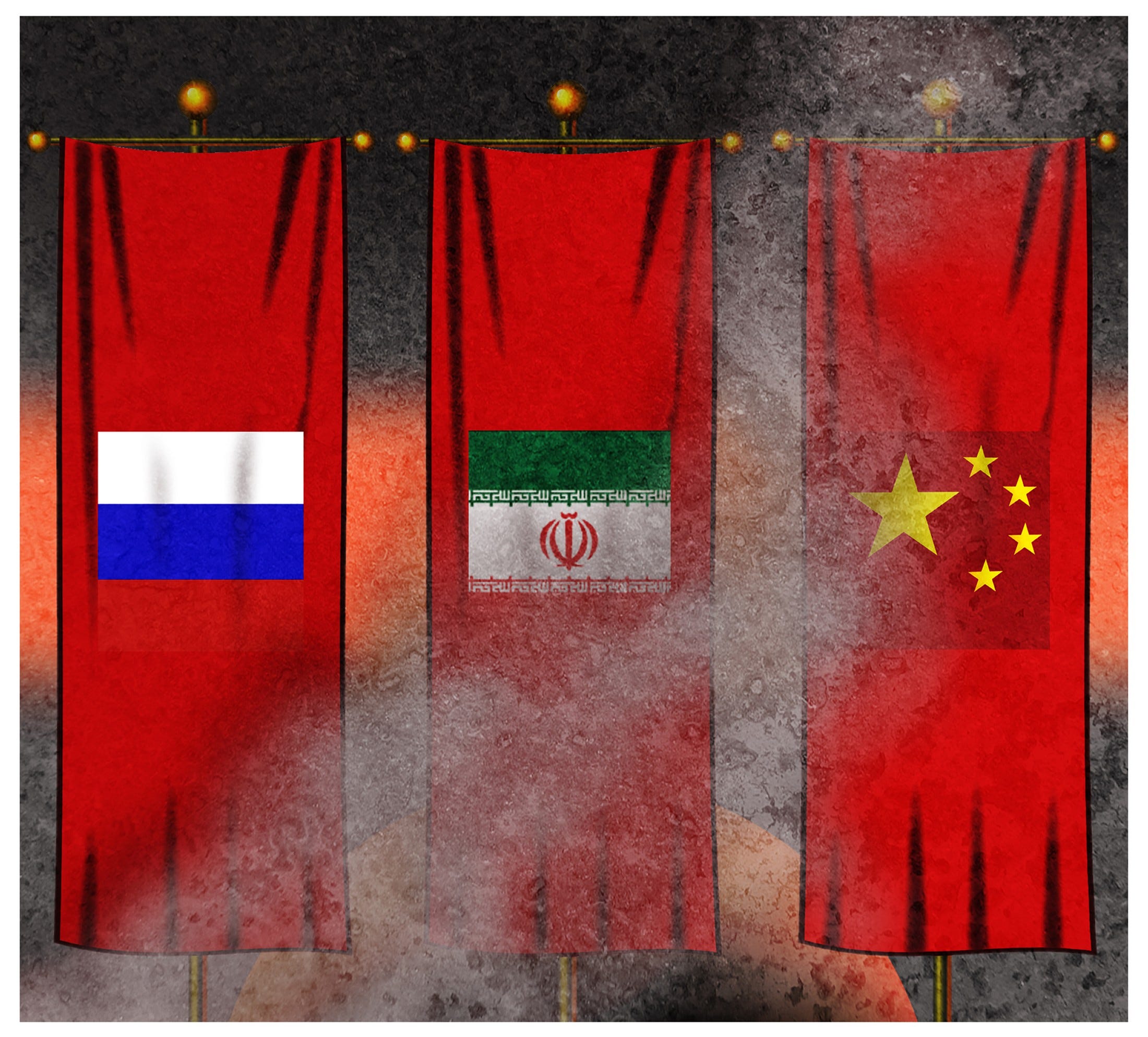
Historically, China and Russia have offered Iran limited protection: diplomatic cover at the United Nations, selective military cooperation, and economic engagement calibrated to avoid secondary sanctions. Neither treated Iran as a treaty ally, and Tehran itself hedged—seeking autonomy rather than dependence, and avoiding full alignment with any bloc. The result was a loose partnership, not a deterrent alliance.
Recent developments, however, are compressing strategic choices. Simultaneous pressure on Iran, Russia, and China—through sanctions, military encirclement, and technological containment—creates incentives for deeper coordination. A collapse of the Iranian regime would not be a local event. For both Moscow and Beijing, it risks either prolonged chaos along critical corridors or the emergence of a U.S.-aligned government in Tehran—a strategic loss with long-term geopolitical consequences.
This dynamic mirrors another of Schelling’s insights: the interaction of threat and chance. By escalating pressure across multiple fronts, Washington may succeed in isolating adversaries one by one—or, conversely, push them into a tighter coalition. Brinkmanship cuts both ways. What is intended as coercion can instead generate alignment.
From Iran’s perspective, the lesson of the 12-day war appears clarifying. The erosion of its regional proxy network and the exposure of vulnerabilities at home have underscored the limits of deterrence built solely on non-state allies. Survival, in Tehran’s view, now requires repairing deterrence through state-level backing. That logic points toward deeper reliance on China and Russia.
Signals of this shift are already visible. In the aftermath of the conflict, high-ranking Iranian military and security officials travelled to both Moscow and Beijing. Reports of expanded defence procurement—from air defence systems to surveillance and missile-related technologies—suggest an effort to rebuild deterrence through external reinforcement. For China and Russia, such cooperation may now align with their broader interest in constraining U.S. power and preventing another regime-change precedent.
Whether this evolves into a true “Eastern axis” remains uncertain. China remains risk-averse, Russia overstretched, and both are cautious about inheriting Iran’s conflicts. But deterrence does not require formal alliances to be effective. Even the perception of coordinated backing—military, diplomatic, or economic—can alter strategic calculations in Washington.
In that sense, the question is not whether China and Russia will fight for Iran, but whether their involvement can raise the cost and uncertainty of coercion enough to restore a measure of deterrence. If so, Iran’s deterrence would not be rebuilt as it once was—through proxies and regional dominance—but through embedding its fate more deeply within a wider confrontation between great powers.
Gunboat Diplomacy
What is unfolding around Iran increasingly resembles a classic case of gunboat diplomacy—the use of visible military power not to initiate war, but to shape negotiations before they begin. The United States’ deployment of heavy assets, including the aircraft carrier USS Abraham Lincoln and its strike group, is not neccessarily a signal of imminent invasion as much as it is a message of leverage. It is a reminder that force remains available, credible, and close at hand.
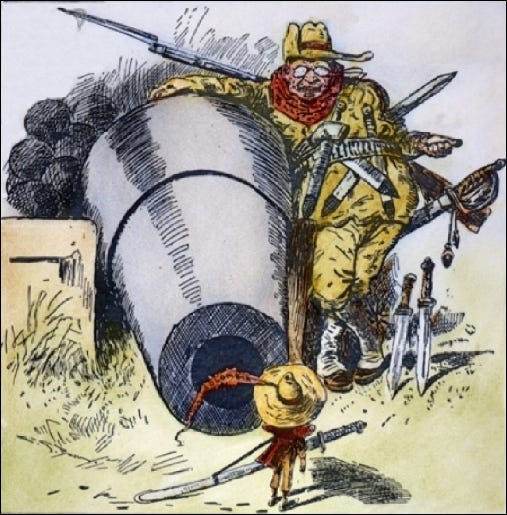
Iran’s response mirrors this logic. By announcing plans for joint naval drills with China and Russia, Tehran is not seeking confrontation at sea, but signalling that pressure will not be one-sided. The message is equally political: Iran is not isolated, and any escalation would carry wider consequences. Both sides are raising the visibility of force while carefully avoiding a step that would lock them into open conflict.
Crucially, these military signals are unfolding alongside parallel declarations of openness to negotiation. Washington continues to stress that diplomacy remains preferable. Tehran insists it is ready to talk—on its own terms. This combination is not contradictory; it is strategic. Force here is not an alternative to diplomacy, but its precondition.
Gunboat diplomacy works by pushing threats to the edge of credibility without crossing it. The goal is to shape the bargaining environment so that when talks begin, they do so under maximum pressure. Each side seeks to enter negotiations with the strongest possible hand, having demonstrated resolve, risk tolerance, and escalation capacity.
In this sense, the build-up around Iran is less about choosing between war or peace than about defining the terms of any eventual deal. Both Washington and Tehran appear to believe that the closer they move toward the brink without falling over it, the better their position will be when they finally sit at the table.
Is This the Last Chance to Strike?
The current moment may represent a narrowing window rather than an open-ended crisis. If President Trump neither authorises a strike nor secures a deal, the confrontation is likely to harden into a prolonged period of strategic standoff—a new form of cold war rather than a decisive rupture.
In such a scenario, Washington would likely intensify maximum pressure without crossing the threshold of open conflict. This would include tighter enforcement against Iranian oil exports at sea, expanded sanctions, financial isolation, and persistent military presence designed to contain rather than collapse the regime. The objective would shift from forcing immediate concessions to steadily degrading Iran’s economic and strategic capacity over time.
Iran, for its part, would adapt. Cut off from relief in the West, Tehran would accelerate its pivot toward China and Russia, deepening economic, military, and technological cooperation. It would work to repair the deterrence damaged by recent conflicts—closing air defence gaps, strengthening internal security, and restructuring its regional posture. Domestically, the regime would likely rely on an increasingly heavy hand to suppress unrest, calculating that survival depends on control first and reform later.
This outcome would not resolve the confrontation; it would freeze it. Both sides would accept a long-term, hostile equilibrium marked by sanctions, covert action, periodic crises, and mutual containment. For Washington, that risks entrenching Iran within an Eastern strategic bloc. For Tehran, it means living under sustained pressure with limited room for recovery.
Seen from this angle, the present escalation may indeed be the last moment when decisive action—whether military or diplomatic—can still reshape the trajectory of the conflict. Once the lines harden and adaptation sets in, leverage diminishes. What follows would not be peace or war, but a drawn-out contest in which neither side wins quickly, and instability becomes the permanent condition.
