Responding to the ongoing war in the Middle East, Pope Leo emphasised that his position is not political, but ethical: “The message of the Church, my message, the message of the Gospel: blessed are the peacemakers.” He added, “I do not look at my role as being political… I have no fear… of speaking out loudly about the message of the Gospel.” His concern was direct and unambiguous: “Too many innocent people are being killed… and someone has to stand up and say there’s a better way.”
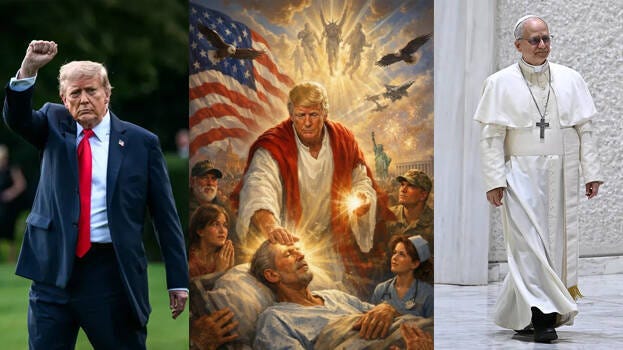
This intervention was quickly met with a political response. Former President Donald Trump dismissed the Pope as “a very liberal person,” accusing him of misunderstanding the realities of security and conflict.
It is not unusual for a religious figure to criticise war and call for peace. However, Trump’s reaction was unusually sharp, raising broader questions about the boundaries of freedom of expression and religious voice within political discourse in the West.
Yet the more significant issue lies beyond this exchange: the moral responsibilities in political engagement. Has politics become a purely Machiavellian arena, detached from ethical considerations? Or do those who engage in politics—whether as leaders, commentators, or analysts—still carry a responsibility to uphold moral integrity?
The Crisis of Ethics in Political Discourse
This is not a leftist argument about the “failure of the West,” but about a deeper transformation within political discourse itself—one marked by the erosion of moral consistency and the selective application of values.
In A Secular Age, Charles Taylor explains how Western societies gradually moved away from religious frameworks across multiple layers—social, cultural, and political. As traditional religious authority declined, it was not replaced by a moral vacuum, but by a new ethical architecture rooted in liberal values: democracy, human rights, equality, and justice. These became the normative foundation of modern Western politics, offering a secular but principled basis for public life.
What we are witnessing today, however, suggests a more troubling shift. It is not simply a continuation of liberal politics, but a movement toward a valueless politics—a space where politics is no longer anchored in either religious ethics or consistent liberal principles. In this emerging environment, values are no longer guiding action; they are increasingly instrumentalised, invoked selectively when convenient and disregarded when they constrain power.
This trend becomes particularly visible in moments of war. When political leaders justify actions that involve deliberate civilian harm, openly support policies widely described as collective punishment or even genocide, threaten the destruction of entire societies, or reduce strategic objectives to material gains such as control over resources—while simultaneously invoking neither religious restraint nor liberal norms—it signals a profound ethical dislocation. The issue is not simply disagreement over policy, but the absence of a stable moral framework guiding political action.
The concern, therefore, is not ideological but structural: ethics are no longer functioning as constraints, but as tools. And when political discourse reaches a point where neither religious morality nor liberal values provides meaningful limits, it suggests the emergence of a far more dangerous landscape—one in which power operates with diminishing accountability to any consistent ethical standard.
Analysis vs Advocacy: Where Is the Moral Line?
The problem is not that analysts or commentators take positions. In complex conflicts, complete detachment is neither realistic nor always desirable. The real issue is whether there remains a clear boundary between analysis and advocacy—a boundary that, increasingly, appears to be eroding.
In principle, analysis seeks to explain, contextualise, and question. It is grounded in evidence, open to complexity, and willing to challenge assumptions—including its own. Advocacy, by contrast, aims to persuade, mobilise, and defend a position. It simplifies reality, prioritises messaging, and often aligns itself with a particular political objective.
What we are witnessing today is a growing convergence between the two. Many political commentators and analysts are drifting away from analytical integrity toward narrative alignment—selectively presenting facts, amplifying partial truths, and at times engaging in disinformation, conspiratorial framing, or openly pro-unjust-war narratives. This is not always driven by ideology alone, but also by structural pressures: maintaining access to political circles, avoiding professional consequences, and navigating an environment where dissenting views can carry reputational or even legal risks.
In parts of the West, there is a rising tendency to regulate speech under broad and sometimes contested categories such as “hate speech,” which, in certain contexts, creates a chilling effect. While the intent may be to protect communities, the outcome can also discourage critical analysis, pushing commentators toward self-censorship or alignment with dominant narratives to avoid being marginalised, deplatformed, or penalised.
The result is a discourse where analysis increasingly resembles advocacy, and where the line between informing the public and shaping opinion becomes blurred. This does not mean that all commentary is compromised, but it does suggest a systemic drift that weakens the credibility of public debate.
The key point is simple: taking a position is not the problem—losing analytical integrity is. When explanation turns into justification, and questioning gives way to messaging, analysis ceases to serve the public and instead becomes part of the machinery of persuasion.
Political Narratives and the Ethics of Responsibility
Political commentators and public voices play a decisive role in shaping how wars are understood. They do not merely describe events—they frame them. Through their language, emphasis, and interpretation, they influence how audiences perceive legitimacy, responsibility, and necessity. In this sense, commentary becomes part of the conflict itself.
Political voices have the power to shape public perception, legitimise policies, and normalise violence. This often operates through three key mechanisms. First is narrative construction—selecting which facts matter, which contexts are highlighted, and which are ignored. Second is emotional mobilisation, where fear, outrage, or moral urgency are invoked to align public sentiment with particular political positions. Third is the simplification of complex realities, reducing multi-layered conflicts into binary frameworks of good versus evil, security versus threat, or civilisation versus chaos.
The problem arises when commentary moves beyond explanation into justification of illegitimate violence. At that point, it ceases to inform and begins to persuade in a one-directional manner toward an unethical direction. The line between analysis and propaganda is crossed when the purpose of discourse is no longer to understand reality, but to legitimise predetermined outcomes, leading to illegitimate violence and mass killing of innocents.
This is where the question of responsibility becomes unavoidable. Ethics in political engagement is not optional—it is both a professional duty and a public obligation. Those who operate within political and intellectual spaces carry different forms of responsibility. Politicians hold the responsibility of power, as their decisions directly shape lives and outcomes. Commentators hold the responsibility of influence, as they shape how those decisions are understood and accepted. Academics and researchers hold the responsibility of truth, grounded in evidence, integrity, and critical inquiry.
When these responsibilities are neglected, the consequences extend beyond poor analysis. They contribute to a political environment in which violence can be justified, complexity can be erased, and accountability can be weakened. In times of war, maintaining ethical standards in discourse is not a luxury—it is a necessity for preserving both public trust and the integrity of political life.
Political commentators have blood on their hands
When political commentators abandon integrity and help justify illegitimate wars and mass killing, they are no longer observers—they become participants. By shaping narratives that normalise violence, silence dissent, or obscure reality, they contribute to the conditions that allow such actions to continue. In doing so, they share responsibility—not only for the discourse, but for the human consequences of the wars they help legitimise.