

The Big Picture | Between War and Diplomacy
The Middle East is entering another period in which military escalation and diplomacy are advancing in parallel. Washington is weighing its next steps toward Iran after senior national-security officials met at Camp David, while Tehran is preparing for a potentially broader response if large-scale US attacks resume—even as diplomatic channels remain open.
The same tension is playing out in Yemen. Saudi-backed forces have launched a major counteroffensive against the Houthis, with fighting reaching the strategically vital Bab al-Mandeb area, while Riyadh continues to explore ways of containing the conflict diplomatically. Reuters
Taken together, these developments point to a region preparing for war while still searching for an exit from it. The question for the coming days is whether military pressure will strengthen diplomacy—or close the remaining space for it.
My Top 5
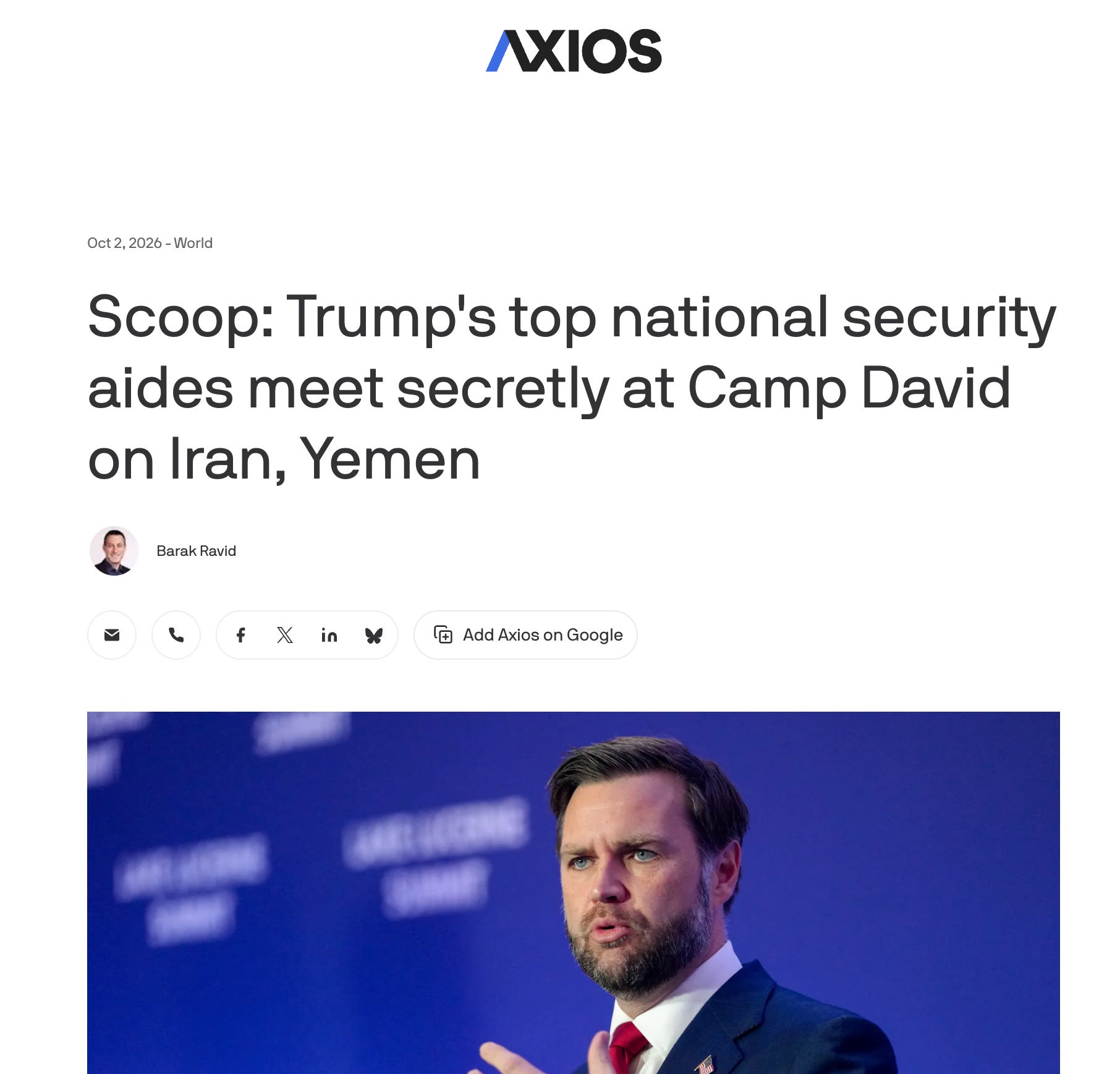
1. Washington weighs renewed war with Iran at secret Camp David meeting
Senior US officials reportedly discussed stalled diplomacy, possible renewed large-scale military operations against Iran, and Yemen. Combined with additional US deployments and Iranian preparations, it raises the central question of whether the ceasefire/pause is becoming only an interval between two rounds of war.
2. Saudi Arabia prepares major Yemen offensive while testing diplomacy with Iran
Saudi Arabia is preparing a potentially major Saudi-backed Yemeni offensive around Bab al-Mandeb and the Red Sea coast, while Saudi Arabia, Turkey and Pakistan simultaneously consider an Iranian proposal for political engagement with the Houthis. This is strategically more important than reporting each development separately because it suggests a classic fight-and-negotiate strategy: improve the military balance before negotiating.
Reuters investigation into Saudi military preparations
Reuters on the Saudi-Turkish-Pakistani talks


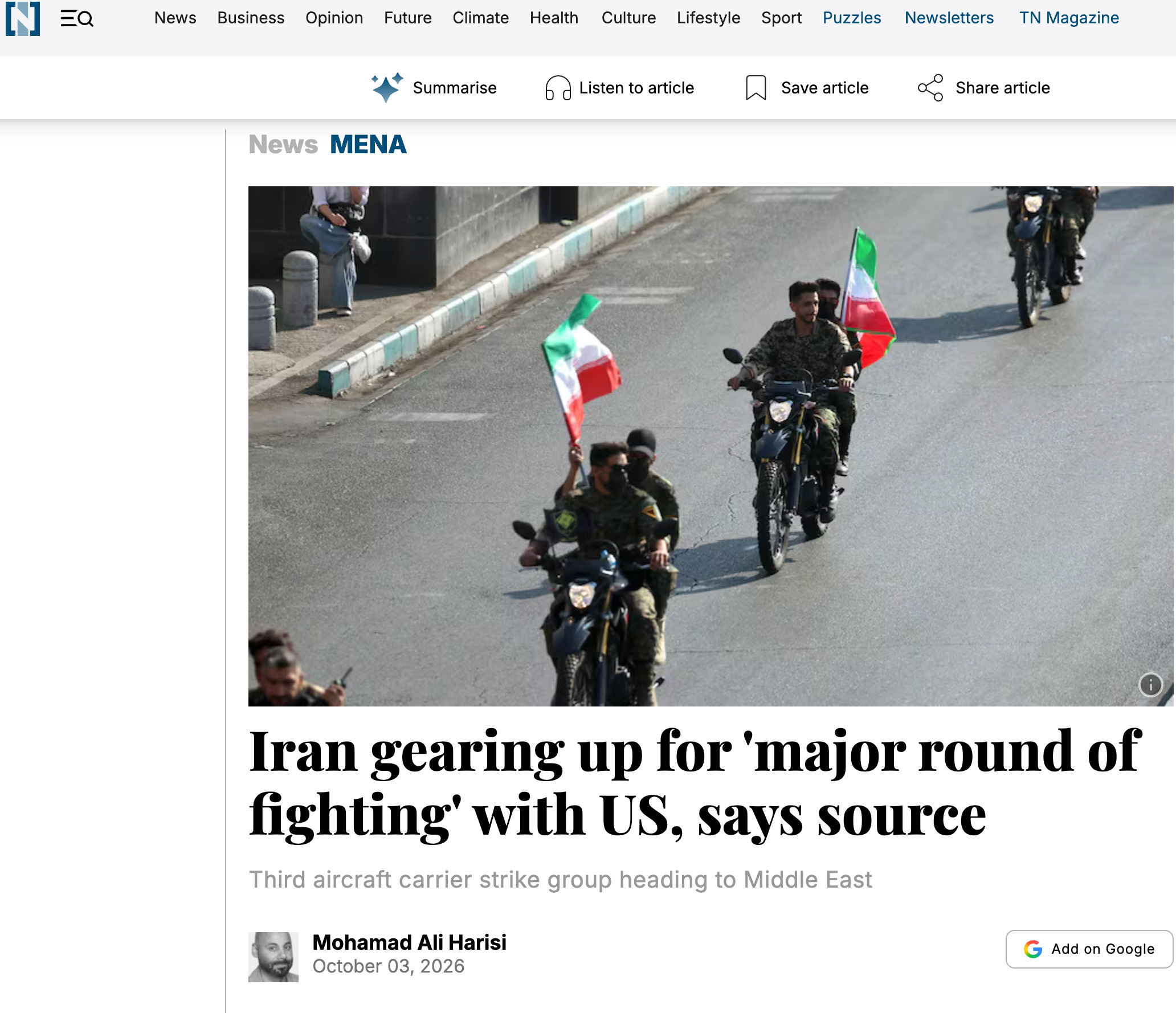
3. Iran prepares for the possibility of another major round of war
Tehran fears another attack; it is reportedly making military preparations on the assumption that the US military option remains active while simultaneously leaving diplomacy open.
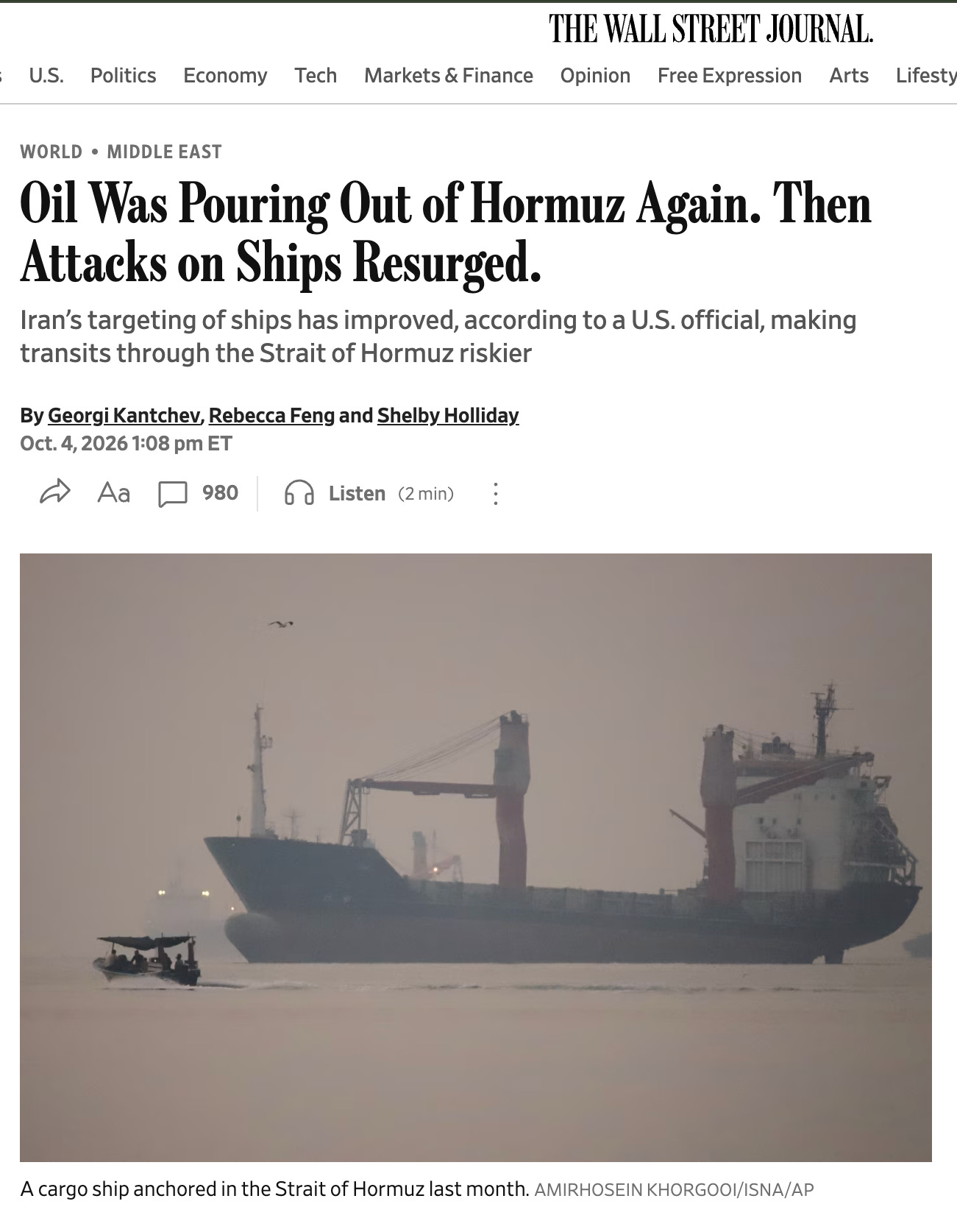
4. Hormuz is functioning again—but under an extraordinary US-protected maritime system while Iran continues targeting ships
Oil and gas traffic has recovered substantially, but shipping is operating under heightened US military protection while attacks continue. The strategic question is whether this represents a sustainable new equilibrium or merely a temporary mechanism keeping the world’s most important energy chokepoint functioning during an unresolved war.
Financial Times on the recovery of Gulf energy exports
Wall Street Journal on renewed attacks in Hormuz

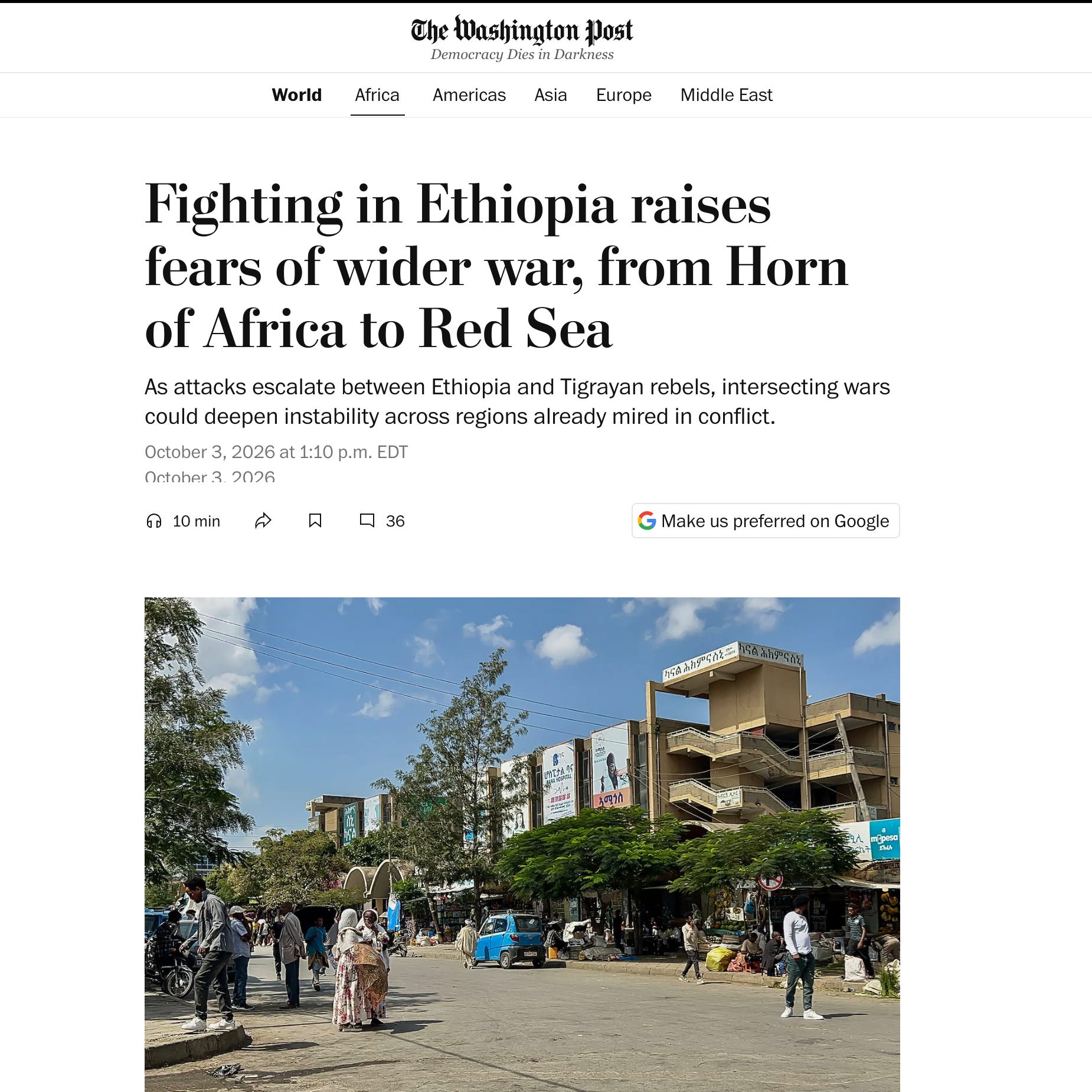
5. Ethiopia’s Tigray war risks becoming a wider Horn of Africa conflict
Renewed fighting in Tigray is intersecting with the Ethiopia-Eritrea rupture and Ethiopia’s accusations against Egypt and Sudan. That potentially connects the Tigray conflict with Red Sea competition, GERD tensions and the wider struggle for influence in the Horn of Africa.
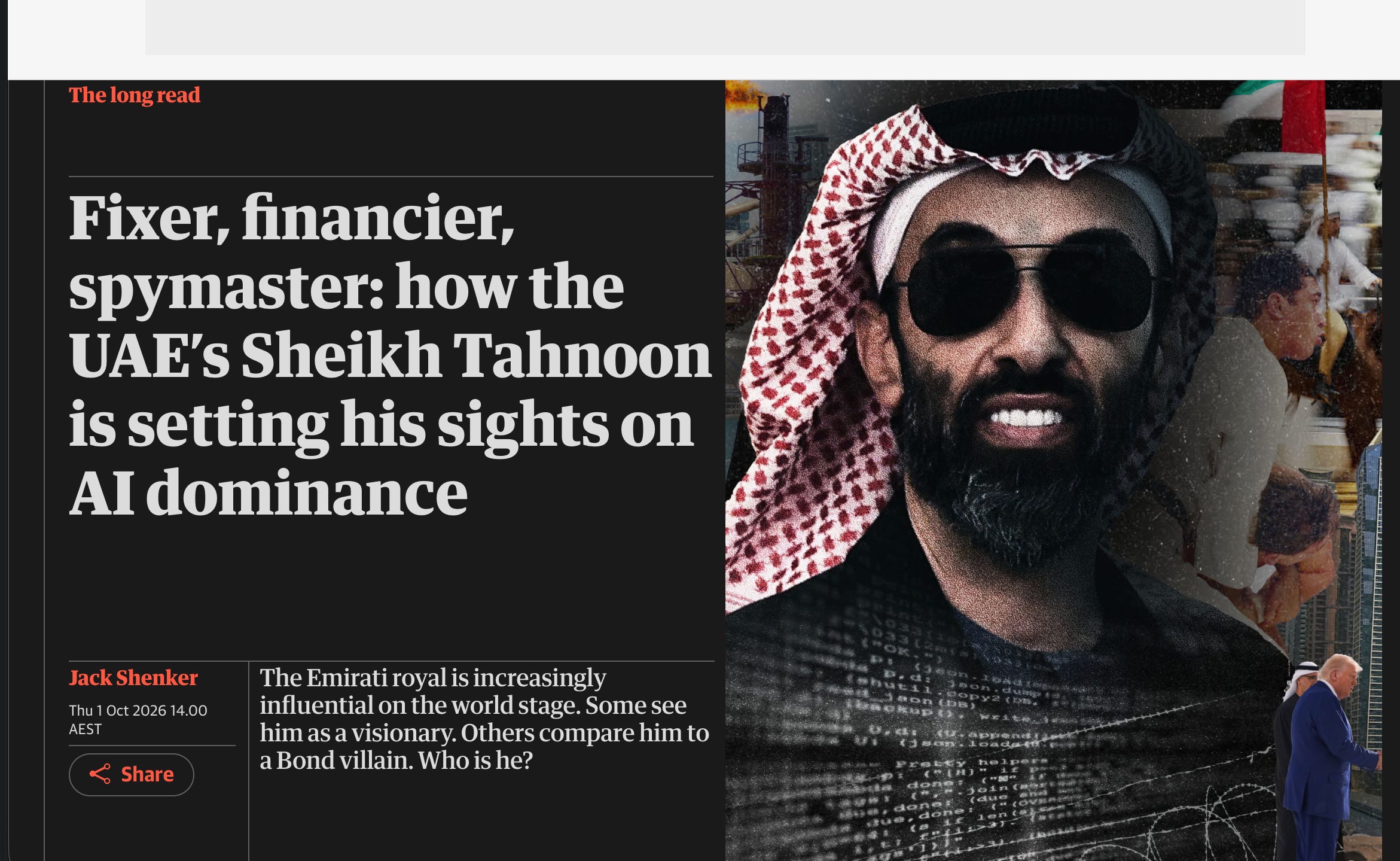
Beyond the Headlines | Sheikh Tahnoon and the New Architecture of Emirati Power
One of the most revealing stories this week is not about a battlefield, but about the extraordinary concentration of money, intelligence, technology and geopolitical influence around Sheikh Tahnoon bin Zayed Al Nahyan, the UAE’s national security adviser. A major investigation by The Guardian portrays Tahnoon as occupying an unusual position at the intersection of Abu Dhabi’s security establishment and an economic empire it estimates at around $1.5 trillion, spanning sovereign wealth, banking, infrastructure and technology.
The most consequential part of this story is artificial intelligence. Tahnoon chairs G42, which has become deeply connected to the American technology ecosystem. Microsoft has invested $1.5 billion in G42, while the company and its associated AI investment fund have partnerships or investments involving OpenAI, Anthropic and xAI. At the same time, the Guardian traces personnel links between G42 and earlier Emirati cyber-security operations, including DarkMatter and Project Raven—claims G42 disputes, saying it was established as an AI and technology company and operates under rigorous security and compliance frameworks.
The larger significance goes beyond one powerful Emirati royal. Abu Dhabi appears to be pursuing a model in which capital, state security and emerging technology reinforce one another as instruments of national power. The UAE’s planned AI campus is projected to reach 5GW of capacity, while G42 is also participating in large-scale US data-centre investment. This places a relatively small Gulf state increasingly close to the infrastructure on which the next generation of global AI may depend.
Why it matters: The traditional sources of Gulf influence were oil, sovereign wealth and strategic geography. The emerging model adds something potentially more consequential: control over data, computing capacity and AI infrastructure. Sheikh Tahnoon’s rise therefore offers a window into how Gulf power itself is changing—from energy wealth financing geopolitical influence to wealth being converted into technological and informational power.
What I’m Watching
After Riyadh — Can the Mecca Pact open a political track with the Houthis?
Saudi Arabia, Türkiye and Pakistan convened the Mecca defence pact committee in Riyadh on 5 October amid an escalating Saudi-Houthi confrontation. Iran has proposed political engagement with the Houthis as an alternative to further military escalation. The key signal to watch is whether the three states turn that proposal into an actual diplomatic channel—or whether Riyadh’s military campaign in Yemen becomes the dominant track.
Hormuz — Are recovering oil flows sustainable?
Middle Eastern crude exports recovered sharply in September, at times exceeding pre-war levels, but the rebound remains extremely fragile. At least seven tanker attacks have been reported since late September, while shipping and insurance costs remain exceptionally high. Watch whether tanker traffic continues recovering despite the attacks—or begins falling again. That may be one of the clearest indicators of whether the region is moving toward economic stabilisation or another energy shock.
Washington and Tehran — Is the next round military or diplomatic?
After senior US national-security officials met at Camp David to discuss Iran and Yemen, the central unresolved question is whether Washington is preparing renewed military operations or using the threat of escalation to strengthen its negotiating position. Iran, meanwhile, says reopening Hormuz remains conditional on implementation of terms discussed through intermediaries. The signal to watch is not rhetoric but movement: new US force deployments, another round of mediated talks, or concrete steps toward implementing a maritime agreement.
From MENA Nuance | Latest Analysis
Trump Says a ‘Big Decision’ on Iran Is Coming. What Are His Options?
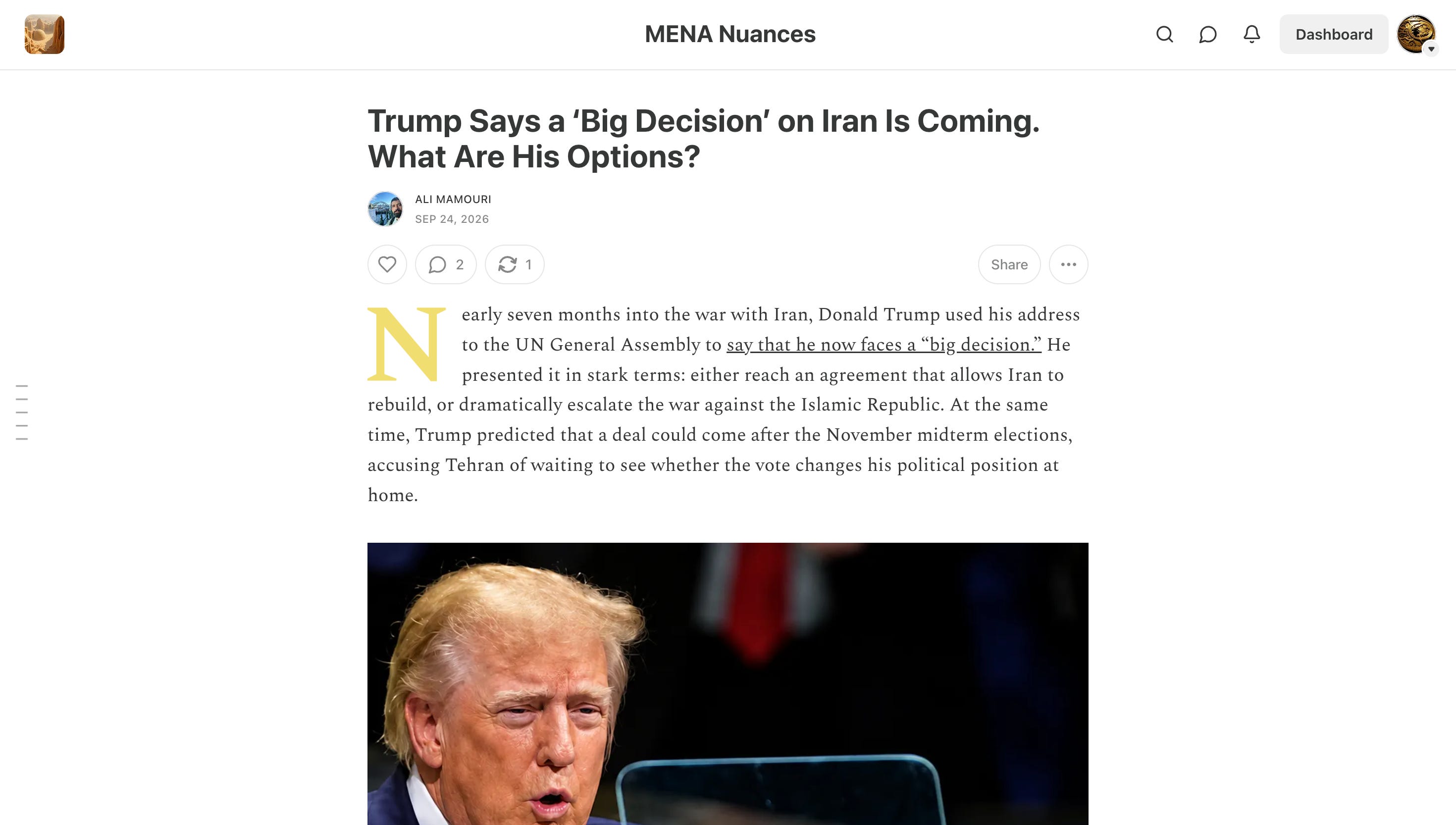
Trump frames the choice as diplomacy or overwhelming force, but Washington’s real options are more complicated—and none offers an easy path out of the escalating confrontation with Iran.
Video / Podcast
Inside the Hostage Negotiations — Brett McGurk on Brink
In this extended conversation, Brett McGurk—President Biden’s former Middle East coordinator and one of the central U.S. negotiators after October 7—takes listeners inside the diplomacy behind the hostage and ceasefire negotiations that followed the Hamas attack. The discussion accompanies his new book, Brink: Inside the Race to Free the October 7 Hostages, released on 6 October.
One particularly revealing part of McGurk’s account concerns what was happening immediately before October 7. He says Saudi ambassador Princess Reema bint Bandar was in his White House office on 6 October 2023 as Washington and Riyadh worked toward a package involving Saudi-Israeli normalization, a U.S.-Saudi civil nuclear agreement, and a political pathway for the Palestinians. According to McGurk’s account, the parties were working toward completing the framework by the end of 2023 and launching it in early 2024. The October 7 attack abruptly transformed that diplomatic landscape.
The conversation is also worth hearing critically. Brink presents an insider’s defense of the Biden administration’s crisis diplomacy: McGurk argues that U.S. officials repeatedly came close to agreements and worked to prevent the Gaza war from becoming a wider regional conflict. Yet the book arrives amid continuing debate over precisely that record—particularly whether Washington’s approach to Israel and Gaza contained escalation or helped create the conditions for the much broader regional confrontation that followed. The result is more than a memoir of negotiations: it is an important contribution to the emerging argument over how the post-October 7 Middle East reached its present point.
[Watch the full conversation →]
Also worth watching: McGurk is discussing Brink with Washington Post foreign-affairs columnist David Ignatius at the Atlantic Council, focusing on Gaza, the U.S.–Israel relationship, Iran, and the future of American Middle East policy.
[Brett McGurk on Brink — Atlantic Council]